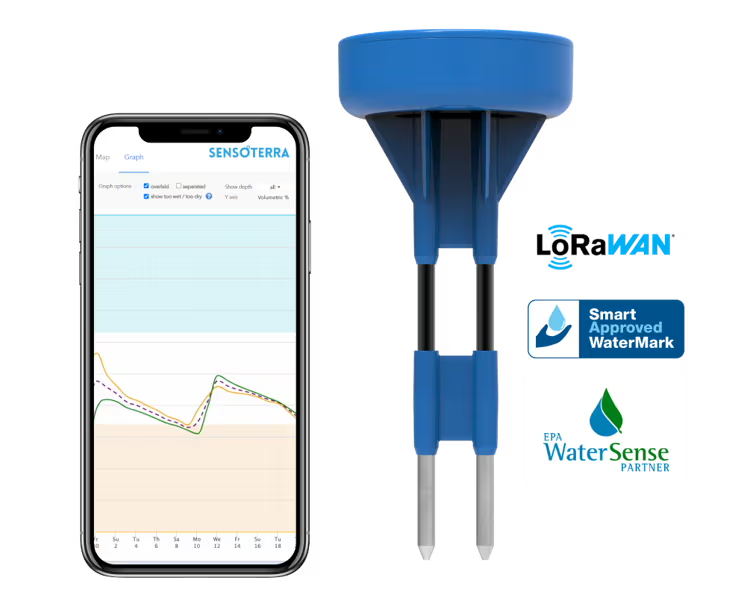
Move beyond guesswork with soil moisture probes

Optimize hull split, prevent root rot, and safeguard your orchard’s future with Sensoterra’s wireless moisture intelligence.

In the arid heat of the Central and Yuma Valleys, water is the single most powerful lever for yield. Every gallon delivered to your almond, walnut, or pistachio blocks must serve a biological purpose. Sensoterra shifts your operation from broad estimation to surgical execution by providing a live nervous system for your soil.

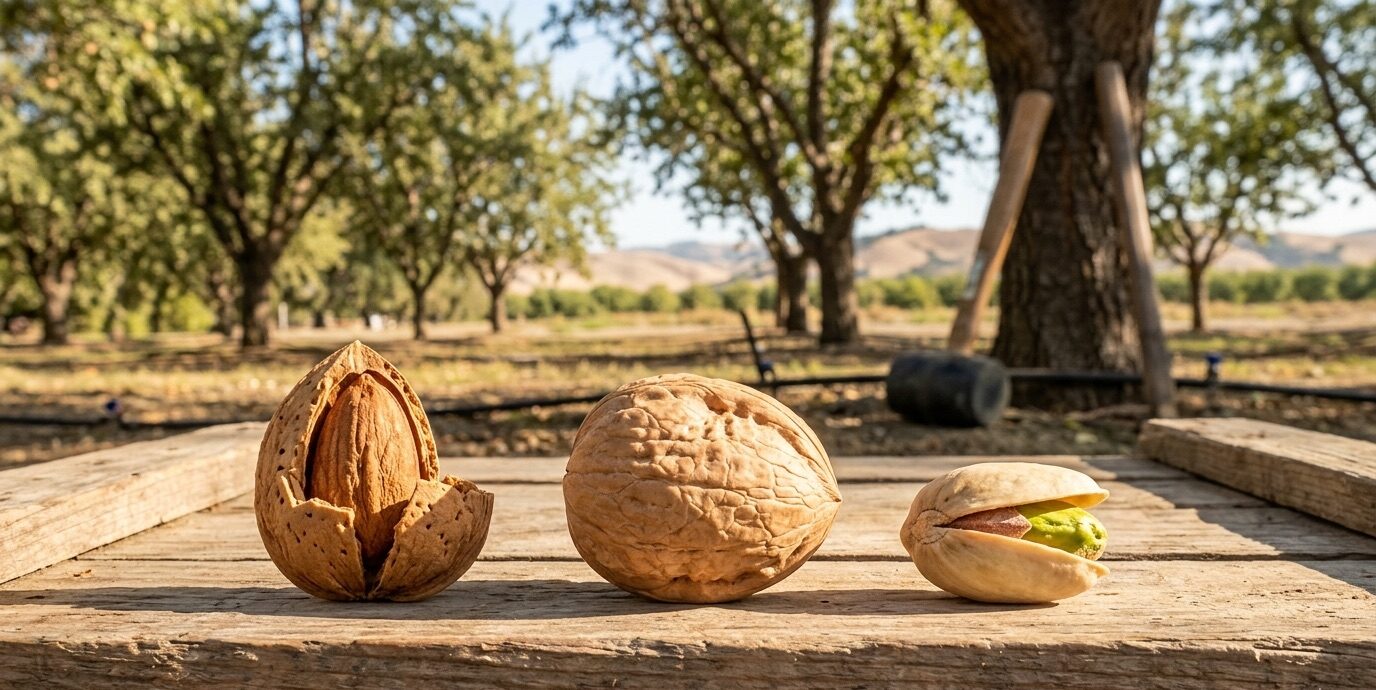
According to California Department of Water Resources precision irrigation plays a critical role in achieving sustainable water use across the state.

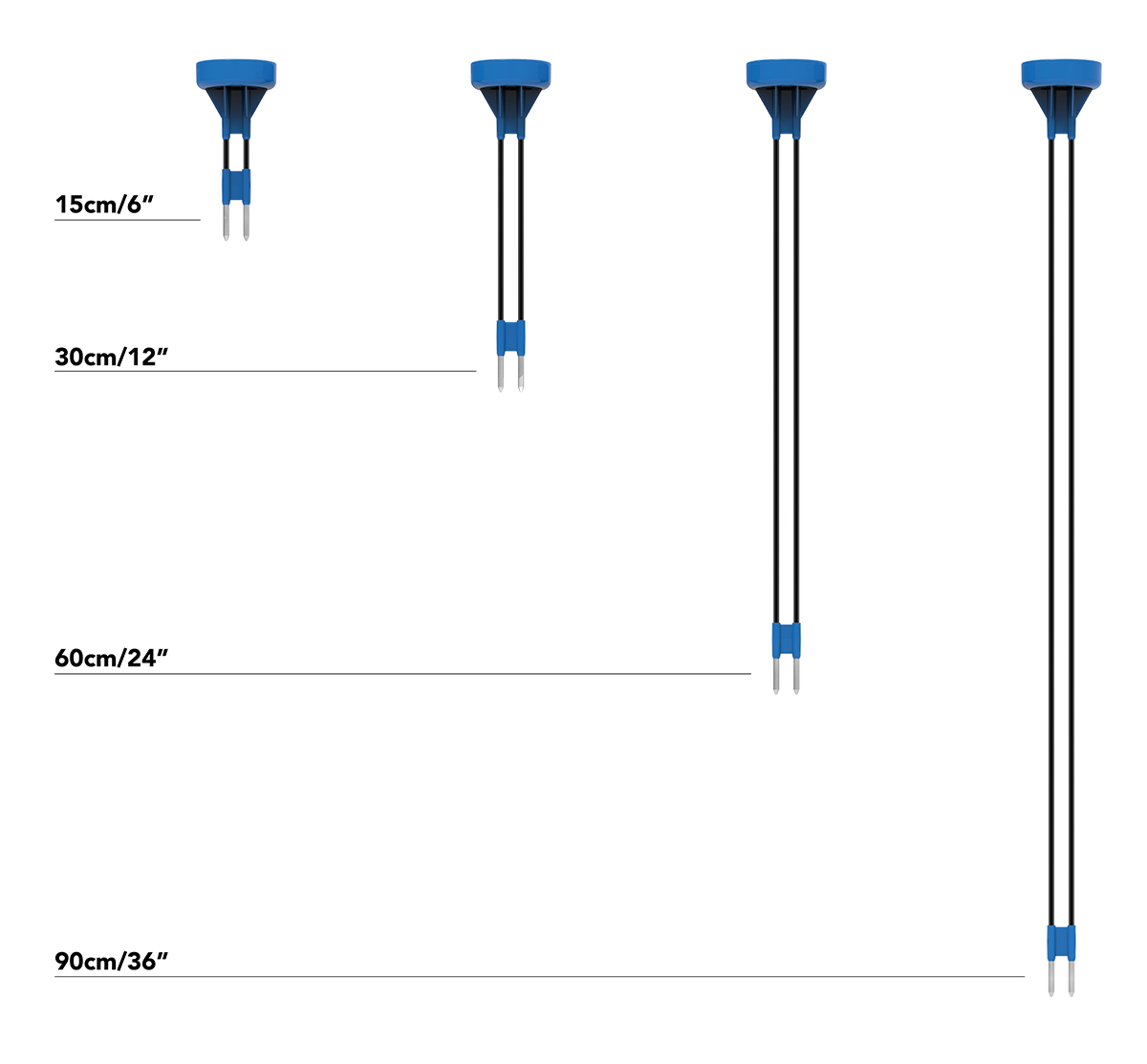
Single depth sensor all lengths

100% maintenance free

No wires, no fuss

Highly secure data connection

Suitable for all soil types

Field-Hardened soil probes

Forget fragile lab equipment. Our technology is forged for the grit of commercial nut production.

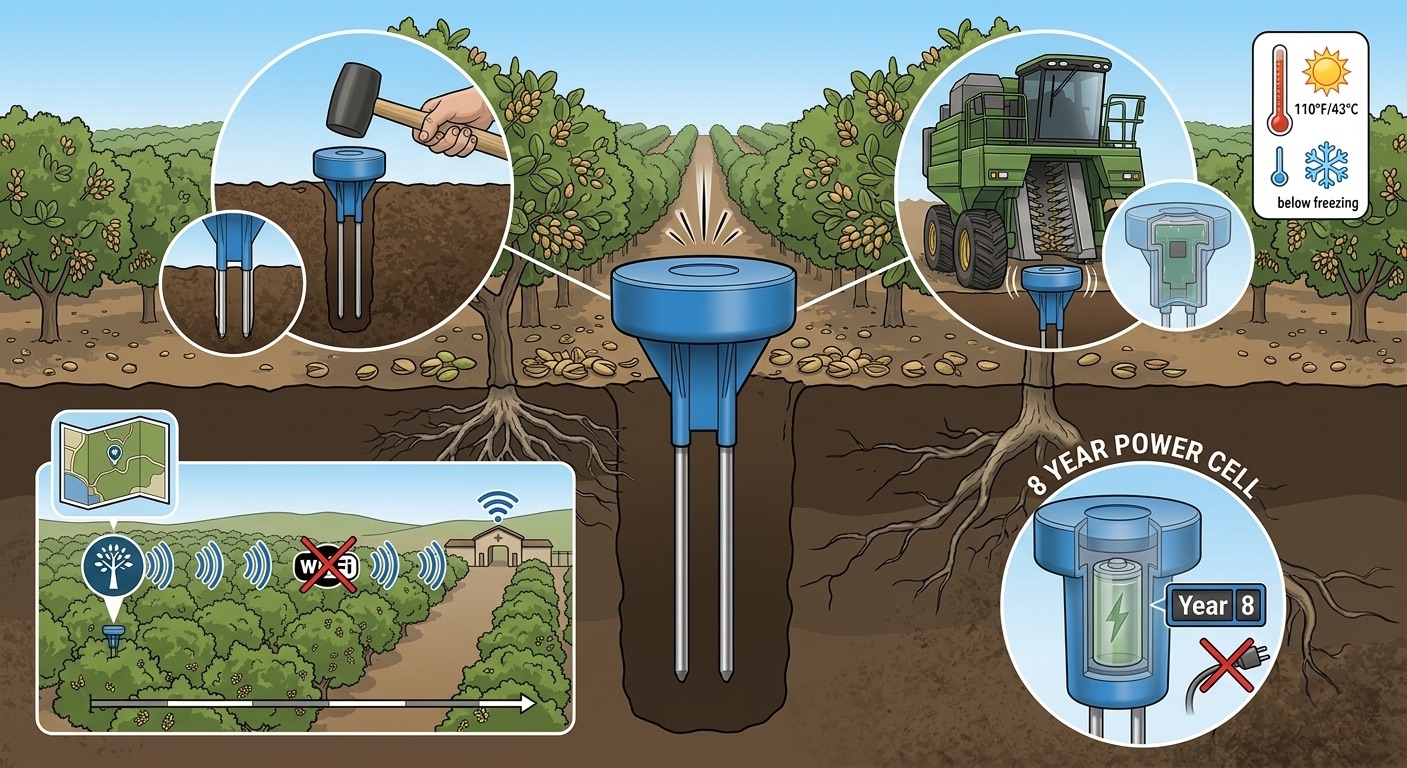
  • The Mallet Driven Advantage Eliminate the air pockets that plague traditional sensors. Our units are driven directly into undisturbed earth with a rubber mallet, ensuring an immediate and authentic connection to the root zone.

  • Encapsulated Resilience Vacuum sealed in high impact resin, these sensors endure the vibration of heavy shakers and the crushing weight of harvest machinery. They survive 110°F Arizona summers and sub-zero winter freezes without a single maintenance visit.

  • The 8 Year Power Cell A fully autonomous battery life spans nearly a decade. No wires to trip over and no seasonal charging required. Install once and harvest data for the better part of a decade.

  • LoRaWAN Range Low power radio signals penetrate even the densest walnut canopies. Data travels miles from remote orchard blocks to a single gateway, bypassing the need for expensive field wide Wi-Fi.

Crop Specific Command

Every nut variety follows a unique physiological clock. Our data helps you hit every milestone with clinical accuracy.

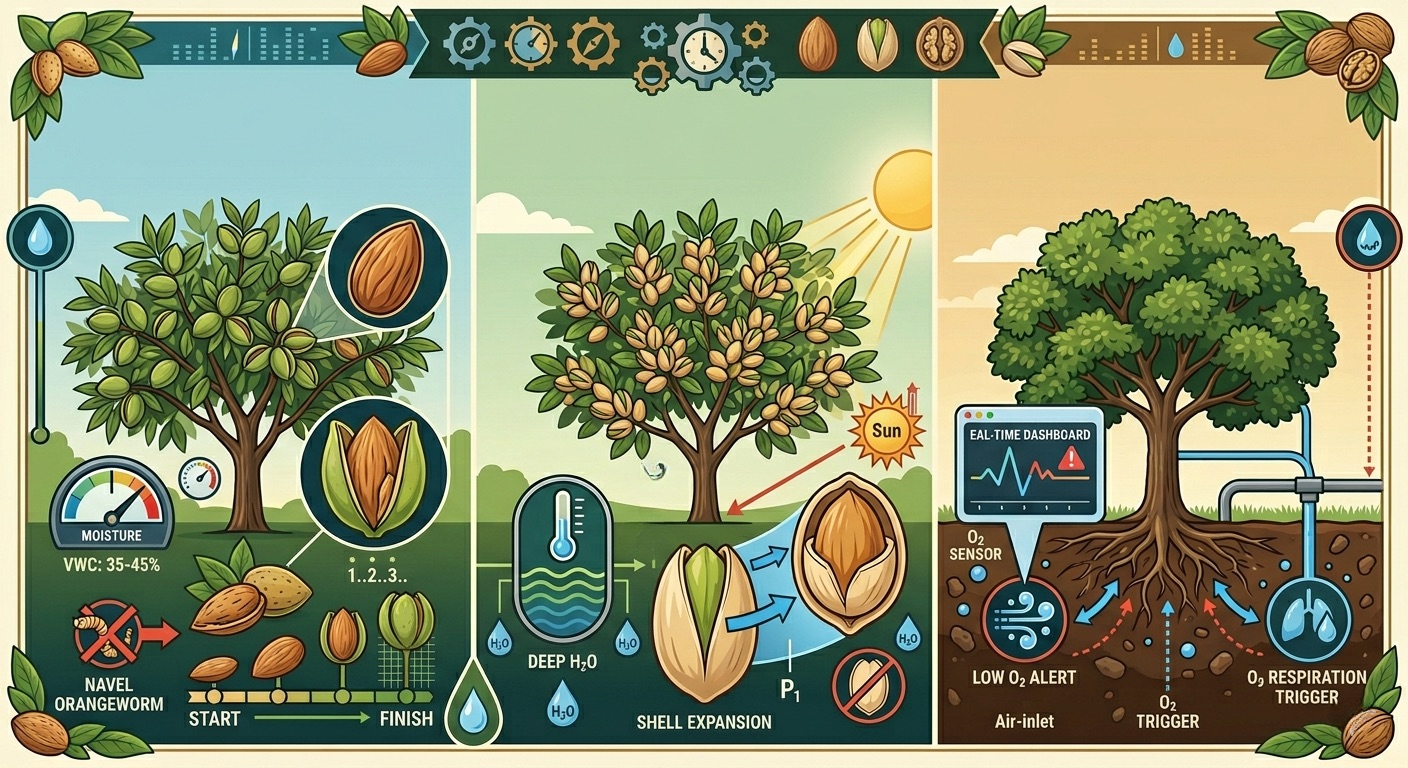
Almonds: The Hull Split Strategy Control the ripening process by managing Volumetric Water Content (VWC) with precision. Target specific deficits to force uniform maturity while simultaneously crushing the risk of Navel Orangeworm.

Pistachios: Ending the Empty Shell Prevent “blanks” by securing moisture reserves during the critical shell expansion phase. Use deep profile data to ensure your trees have the hydraulic pressure needed to fill every nut during peak heat spikes.

Walnuts: Oxygen over Saturation Walnuts are vulnerable to root rot in heavy clay. Our real time dashboards alert you the moment oxygen returns to the soil, ensuring you pulse irrigation only when the tree is ready to breathe.

The “hidden” ROI: Operational & financial wins

Beyond labor and water, several “secondary” benefits create a compounding return on investment.

  • Pumping & energy cost reduction In 2026, energy prices for groundwater pumping are a major overhead. By cutting irrigation events by 15–30%, you directly reduce your monthly utility bill and the wear-and-tear on expensive pump motors and filtration systems.

  • Fertilizer micro-dosing (fertigation) Probes at the 36-inch “Sentinel” depth act as a financial bodyguard. They alert you if your expensive liquid Nitrogen is leaching past the root zone. By keeping nutrients in the “active zone,” growers are reporting up to a 50% reduction in fertilizer waste.

  • Disease prevention (shrinkage) Over-watering is the primary cause of Phytophthora and root rot in walnuts and almonds. Sensor-guided irrigation has been shown to reduce disease-related tree “shrinkage” from 30% to near zero in saturated soils, protecting the long-term value of your land.

  • Regulatory resilience Under the 2026 SGMA (Sustainable Groundwater Management Act) mandates, unmeasured water use is a liability. Having a digital log of your soil moisture levels provides the “defensible data” required to protect your pumping rights during state audits.

How Sensoterra Enhances Almond Irrigation Decisions

Sensoterra’s soil moisture sensors give almond growers:

  • Accurate, real-time volumetric water content data at multiple depths throughout the root zone.

  • Wireless connectivity for remote monitoring and irrigation planning.

  • Actionable data dashboards and alerts for proactive irrigation scheduling.

  • Scalable deployments that fit orchard blocks of any size — from trial plots to full commercial acreage.

This kind of on-site moisture insight helps make the most of funding programs like SWEEP and EQIP by proving measurable water savings and building stronger irrigation efficiency proposals.

Full article

Case study California: Optimizing irrigation for tree health

Fredriks Farms, a 195 acre fruit and nut orchard located in the Ripon and Madera region of the Central Valley in California, introduced Sensoterra sensors to monitor soil health and capillary behavior of their trees

Almond irrigation

Trusted by California Growers

“There is a huge need to learn how to better irrigate and control the consumption of water”

“As an industry, we need to improve the efficiency of the data collected in the field and to make better irrigation decisions.”

“It’s simple. You can hammer them straight down into the ground.“

MATT MURRAY, PROCESS TECH AG

The labor multiplier: Radical field efficiency

Traditional irrigation management is labor-heavy, requiring “boots on the ground” for manual soil checks. Probes digitize this process, fundamentally changing how your team spends their day.

  • Elimination of “Windshield Time” Instead of irrigators driving for hours between remote blocks to check soil feel or pressure chambers, managers monitor thousands of acres from a central dashboard. This allows a single skilled technician to manage a territory that previously required a three-person team.

  • Strategic Task Allocation Real-time alerts (via text or app) tell your crew exactly where the trouble is. Instead of a general patrol, labor is deployed only to blocks reaching a “refill point” or showing signs of stress. This “management by exception” prevents the common 2026 issue of worker fatigue during high-heat weeks.

  • Off-Season Retention Because modern sensors like Sensoterra are “set-and-forget” with 8-year batteries, they don’t need to be pulled for winter. This removes the labor-intensive “install/uninstall” cycle, allowing your core team to focus on high-value winter tasks like precision pruning and equipment overhaul.

Advanced Almond Management FAQ:

1. How does soil moisture data assist in managing the “Alternate Bearing” cycles common in pistachios and walnuts?

Precise VWC monitoring during the “off-year” prevents over-irrigation of trees with lower water demand, which protects root health and ensures the tree maintains the carbohydrate reserves necessary for a heavy “on-year” bloom.

2. Why is monitoring the “Infiltration Rate” critical for orchards in the heavy clay soils of the northern Central Valley?

By observing how quickly VWC levels rise at different depths after an irrigation set, growers can identify soil compaction or “capping,” allowing them to adjust pulse irrigation cycles to prevent oxygen deprivation in the root zone.

3. How do sensors help walnut growers manage the specific timing of “Pressure Chamber” readings during the spring?

Walnuts often exhibit “luxury consumption” where they look healthy but are over-saturated; sensors identify the exact moment the soil reaches the “Refill Point,” signaling the grower to begin manual stem water potential testing to confirm the tree is ready for the first seasonal irrigation.

4. In what way does VWC data improve the “Hull Split” synchronization in mixed-variety almond blocks?

Since different varieties like Nonpareil and Monterey ripen at different times, placing sensors in each block allows for variety-specific water stress management, ensuring each tree type reaches the hull split milestone without compromising the health of the pollinators.

5. How does multi-depth sensing assist in “Deep Root Conditioning” for young, developing orchards?

By monitoring moisture at 12, 24, and 36 inches, growers can practice “managed depletion” in the upper layers, forcing young taproots to dive deeper into the profile to find water. This creates a more resilient, drought-tolerant tree structure before the orchard reaches full production.

6. What role do moisture probes play in the “Post-Harvest Recovery” phase for California walnuts?

Walnuts are highly susceptible to “Winter Dieback” if they enter dormancy under moisture stress; sensors ensure growers apply the critical “last drink” of the season to keep the wood hydrated against the drying winds of November and December.

7. How does deep-node monitoring (36+ inches) specifically assist in managing the “Salinity Profile” in Yuma Valley pistachio orchards?

In high-salinity desert soils, the 36-inch sensor acts as a “Leaching Guard,” confirming that irrigation events are successfully pushing salts below the active root zone rather than allowing them to wick back up toward the surface during peak evaporation.

8. How can VWC data be used to optimize “Carbon Sequestration” and soil health through cover cropping?

Growers using winter cover crops face a “water competition” risk in early spring. Sensors allow for precise termination timing—showing exactly when the cover crop begins to deplete deep-profile moisture that the nut trees will need for the upcoming bloom and leaf-out.

9. How should growers adjust VWC thresholds when transitioning from traditional flood irrigation to high-efficiency micro-irrigation?

Micro-irrigation creates a smaller “wetted bulb” of soil; sensors must be placed precisely within this bulb to monitor the much faster depletion rates that occur when a tree’s entire water supply is concentrated in a limited soil volume.

10. Why is “Real-Time Nervous System” data more effective than “ET-based” (Evapotranspiration) modeling for orchards with cover crops?

ET models often struggle to calculate the combined water draw of trees and cover crops, whereas soil probes measure the actual remaining water, ensuring that the ground cover doesn’t inadvertently “steal” the moisture intended for the nut crop during critical shell expansion.

Get started with Sensoterra

To get started, answer a few short questions so we can send you a custom quote

request a quote