The Triple Threat: 2026 Production Challenges

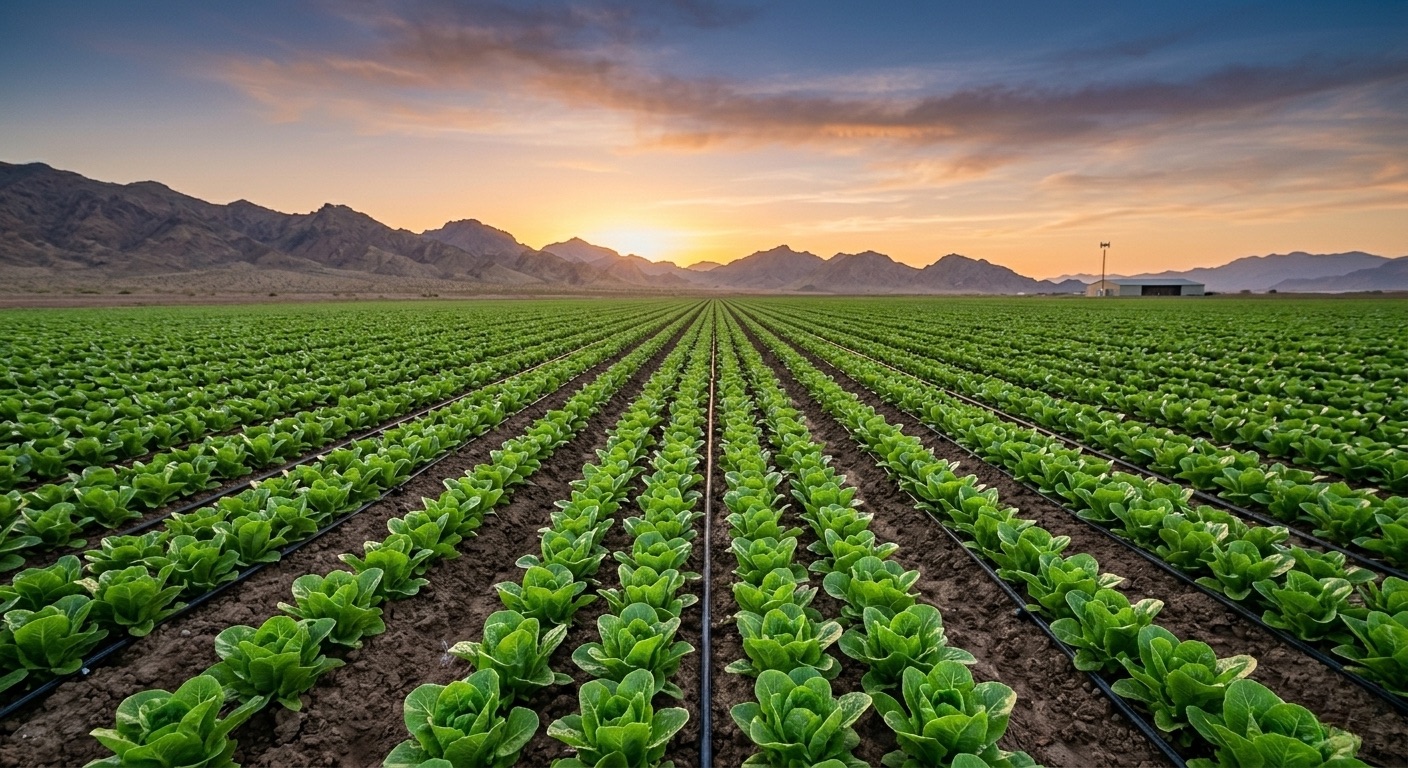
The production of Southwest leafy greens currently faces a critical convergence of water scarcity, soil salinity, and pathogen pressure. This “Triple Threat” has narrowed the margin for error to a thin line where traditional irrigation methods are no longer sustainable.

1. Strategic Water Scarcity

As Colorado River allotments tighten under new federal mandates, growers must transition to high efficiency drip systems. While these systems save water, they require surgical precision to prevent crop stress during high heat spikes.

2. Soil Salinity & Data Accuracy

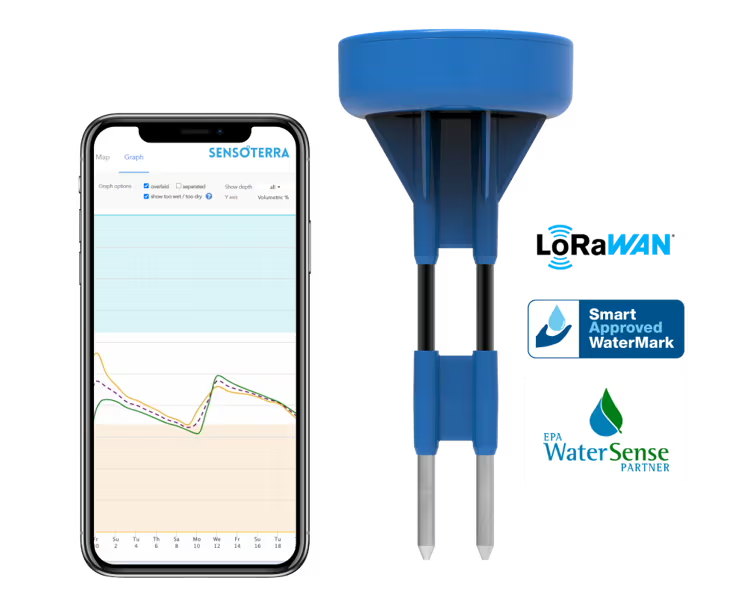
High efficiency irrigation risks trapping toxic salts in the root zone. Standard sensors often fail here because salt distorts moisture data. Sensoterra Dynamic EC technology filters out these distorted readings to ensure your data reflects the pure truth of your soil.

3. Pathogen Control

Over saturation creates humid microclimates ripe for bacteria and mildew. Precision moisture monitoring allows you to maintain the exact levels required for crop cooling and calcium transport without triggering the damp conditions that lead to disease.
According to California Department of Water Resources precision irrigation plays a critical role in achieving sustainable water use across the state.

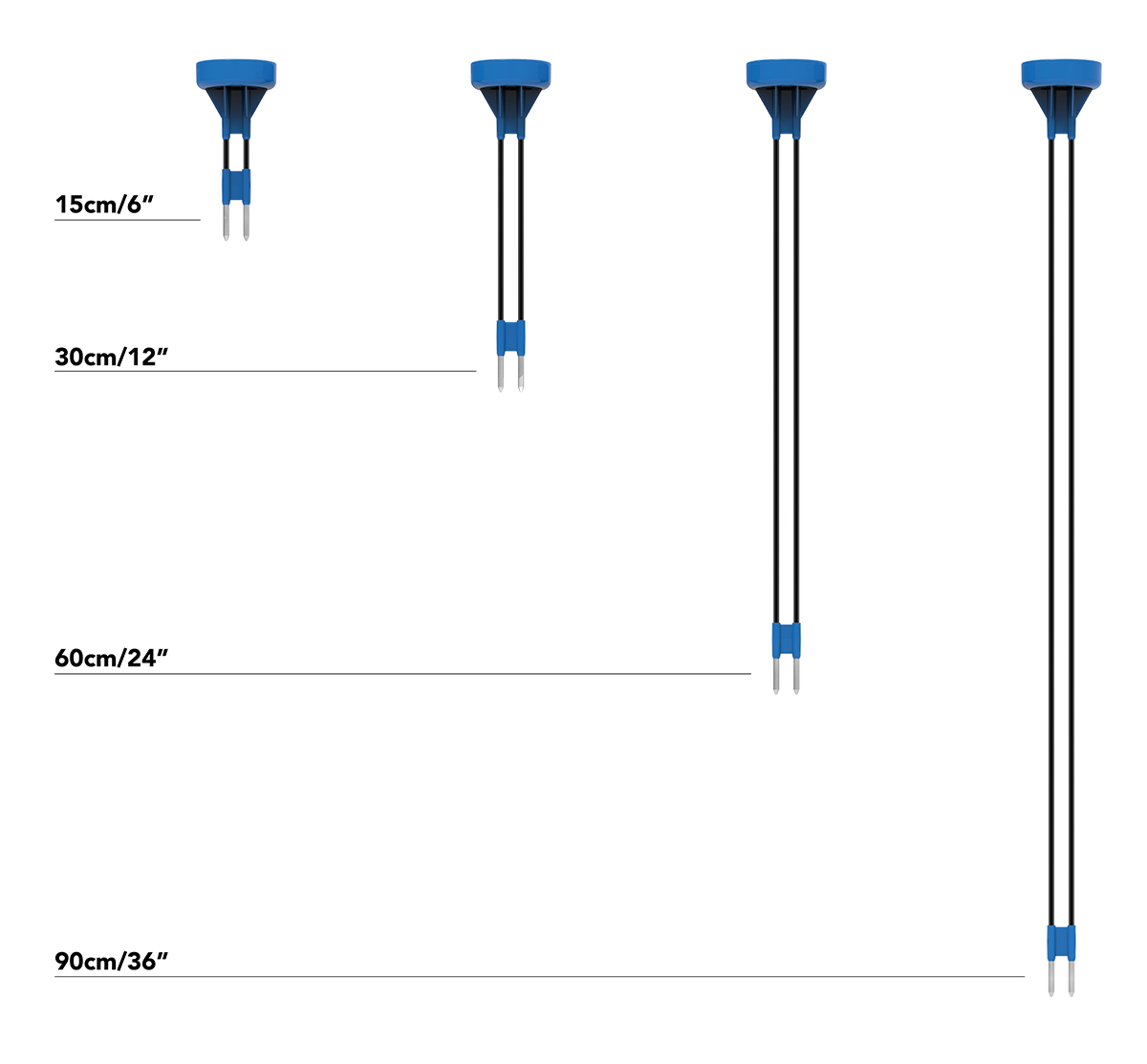
Single depth sensor all lengths

The Bottom Line: In the current 2026 regulatory climate, the sensor is no longer just a tool. It is your primary defense against crop loss, salt buildup, and regulatory non-compliance.

100% maintenance free

No wires, no fuss

Highly secure data connection

Suitable for all soil types

Field hardened soil meters for high rotation

Leafy green production operates on a fast clock, requiring equipment that can keep pace with 60 to 90 day cycles. Unlike permanent orchard installations, these sensors are built for the rapid movement and high intensity of vegetable ranching.

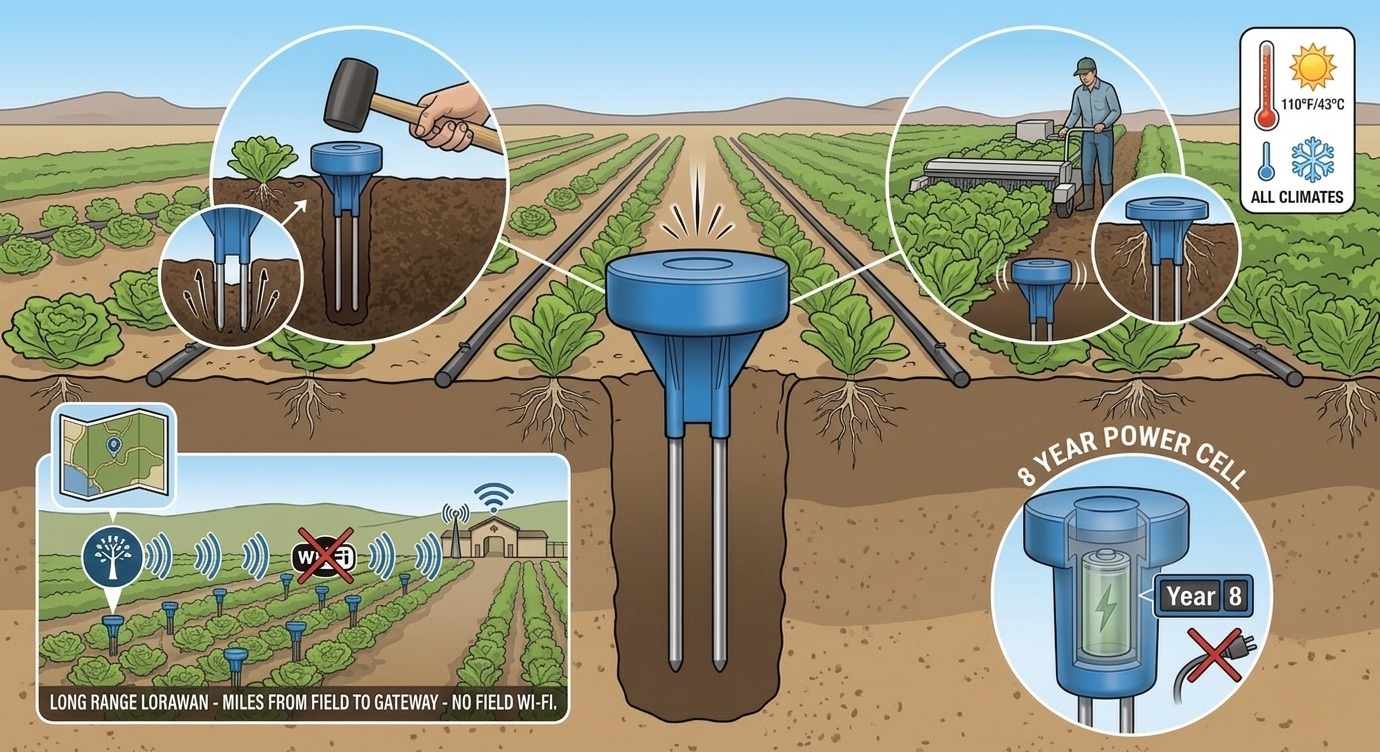
  • Rapid deployment: The wireless design allows for immediate installation using only a rubber mallet. You get an authentic connection to the soil without specialized tools or trenching.
  • Built for the harvest: Vacuum sealed in high impact resin, the units withstand the dust, heat, and vibration of a busy field. The flush to ground profile ensures they stay out of the way of daily operations.
  • Total mobility: Sensors can be installed minutes after seeding and pulled just as quickly before the harvester arrives. This allows your data to follow the crop from block to block.
  • Uninterrupted intelligence: The ease of relocation ensures you maintain a continuous stream of moisture data across multiple rotations throughout the entire season.

Crop-Specific Command

Every leafy green variety follows a unique physiological clock, and hitting critical milestones requires moisture data with clinical accuracy. Our real-time insights allow you to transition from broad estimations to surgical execution for each specific crop in your rotation.

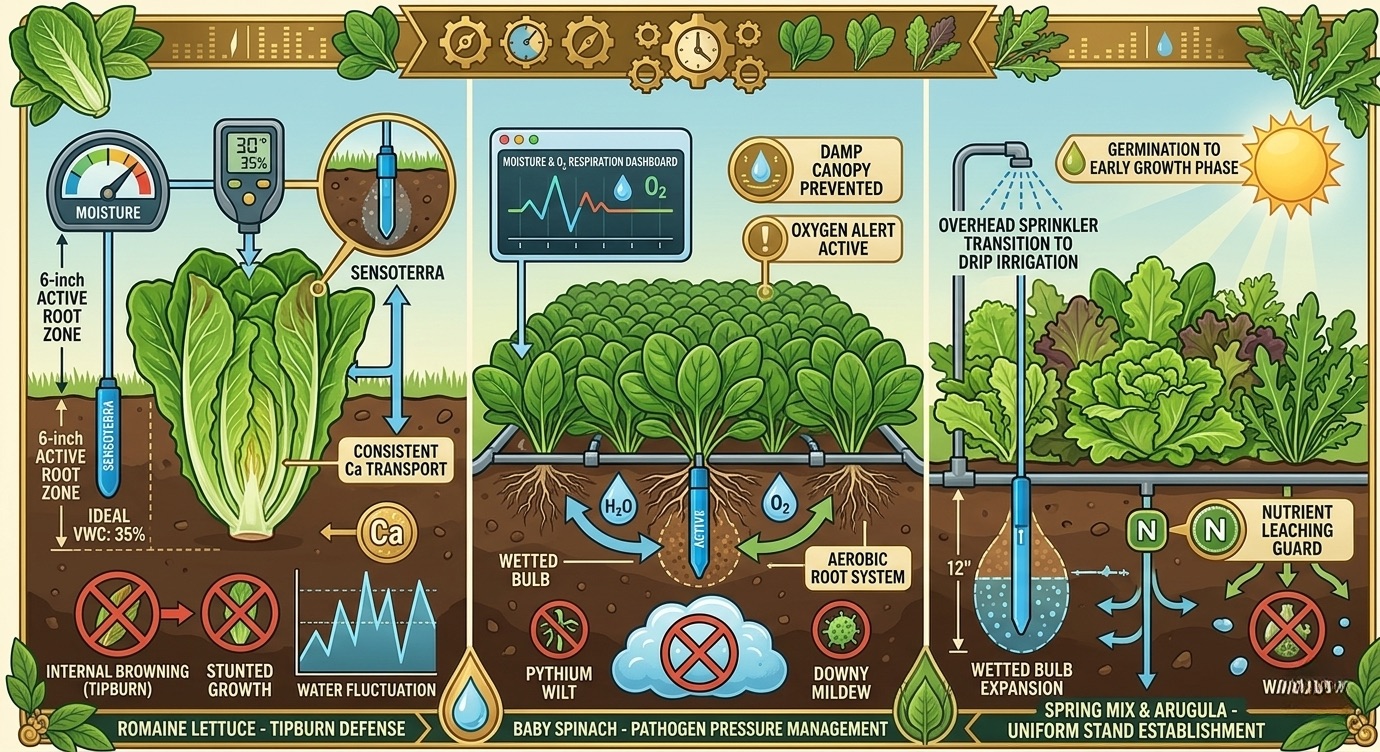
  • Romaine & iceberg lettuce: The Tipburn Defense. Manage Volumetric Water Content (VWC) to ensure consistent calcium transport throughout the head. By maintaining precise moisture levels in the upper 6 inches of the root zone, you prevent the internal browning and stunted growth caused by moisture fluctuations during peak afternoon heat.

  • Baby Spinach: Pathogen pressure management. Maintain the delicate balance between hydration and aeration to crush the risk of Pythium wilt and Downy Mildew. Real-time dashboards alert you the moment oxygen returns to the soil, ensuring you pulse irrigation only when the root system is ready to breathe, keeping the canopy dry and disease-free.

  • Spring mix & arugula: Uniform stand establishment. Secure the success of tender greens during the critical germination and early growth phases. Use high-resolution data to manage the transition from overhead sprinklers to drip irrigation, ensuring the “wetted bulb” provides enough hydraulic pressure to fill out the crop without leaching expensive nutrients.

The “hidden” ROI: Operational & financial wins

Beyond labor and water, several “secondary” benefits create a compounding return on investment.

  • Pumping & energy cost reduction In 2026, energy prices for groundwater pumping are a major overhead. By cutting irrigation events by 15–30%, you directly reduce your monthly utility bill and the wear-and-tear on expensive pump motors and filtration systems.

  • Fertilizer micro-dosing (fertigation) Probes at the 36-inch “Sentinel” depth act as a financial bodyguard. They alert you if your expensive liquid Nitrogen is leaching past the root zone. By keeping nutrients in the “active zone,” growers are reporting up to a 50% reduction in fertilizer waste.

  • Disease prevention (shrinkage) Over-watering is the primary cause of Phytophthora and root rot in walnuts and almonds. Sensor-guided irrigation has been shown to reduce disease-related tree “shrinkage” from 30% to near zero in saturated soils, protecting the long-term value of your land.

  • Regulatory resilience Under the 2026 SGMA (Sustainable Groundwater Management Act) mandates, unmeasured water use is a liability. Having a digital log of your soil moisture levels provides the “defensible data” required to protect your pumping rights during state audits.

Sensoterra’s Soil Moisture Sensors: A Breakthrough Partnership with UC Davis

In an exciting partnership with the esteemed University of California Davis (UC Davis), Sensoterra has embarked on a groundbreaking research project to enhance the accuracy and application of its cutting-edge soil moisture sensors.

The collaboration’s primary focus was on assessing the impact of various factors on soil moisture readings, including salinity effects, sensor-to-sensor variability, and temperature dependency. The culmination of this exceptional partnership resulted in the publication of a scientific paper available to the public: “Assessing Effects of Salinity on the Performance of a Low-Cost Wireless Soil Water Sensor,” available on MDPI.

Full article

California soil moisture sensors: Optimizing irrigation for tree health

In California, every drop of water counts. Ongoing droughts, strict water regulations, and rising production costs push farmers to find smarter, data-driven ways to manage irrigation. Soil moisture sensors give growers real-time insight into what’s happening beneath the surface, helping them decide exactly when and how much to irrigate.

California irrigation

Trusted by California Growers

“There is a huge need to learn how to better irrigate and control the consumption of water”

“As an industry, we need to improve the efficiency of the data collected in the field and to make better irrigation decisions.”

“It’s simple. You can hammer them straight down into the ground.“

MATT MURRAY, PROCESS TECH AG

The labor multiplier: Radical field efficiency

Traditional irrigation management is labor-heavy, requiring “boots on the ground” for manual soil checks. Probes digitize this process, fundamentally changing how your team spends their day.

  • Elimination of “Windshield Time” Instead of irrigators driving for hours between remote blocks to check soil feel or pressure chambers, managers monitor thousands of acres from a central dashboard. This allows a single skilled technician to manage a territory that previously required a three-person team.

  • Strategic Task Allocation Real-time alerts (via text or app) tell your crew exactly where the trouble is. Instead of a general patrol, labor is deployed only to blocks reaching a “refill point” or showing signs of stress. This “management by exception” prevents the common 2026 issue of worker fatigue during high-heat weeks.

  • Off-Season Retention Because modern sensors like Sensoterra are “set-and-forget” with 8-year batteries, they don’t need to be pulled for winter. This removes the labor-intensive “install/uninstall” cycle, allowing your core team to focus on high-value winter tasks like precision pruning and equipment overhaul.

Leafy green precision irrigation FAQ:

1. How do the sensors handle the high-frequency harvesting and replanting cycles of baby greens?

Because the probes are wireless and hammerable, they are designed for “active” management. You can pull a sensor in 30 seconds before the harvester enters and hamer it back into the new bed immediately after seeding, ensuring zero data gaps between rotations.

2. Can I use these sensors to manage the transition from sprinklers to drip?

Yes. For many leafy greens, overhead sprinklers are used for germination before switching to drip. Our sensors provide the transition data needed to know exactly when the sub-soil moisture is sufficient to move to drip without stressing the young stand.

3. Does the 2026 SGMA mandate require real-time data or just total water used?

While mandates vary by basin, “Defensible Data” is becoming the gold standard. Showing why you irrigated (based on soil depletion) rather than just how much you used protects you against claims of wasteful flooding or over-pumping during drought declarations.

4. How many sensors do I actually need for a 40-acre block of lettuce?

For leafy greens, soil variability is the enemy of uniformity. We typically recommend two to three “listening stations” per irrigation set—one near the manifold and one near the tail end—to ensure the entire block is reaching the required VWC.

5. How does the sensor help with “Heat Abatement” cooling sets?

During Southwest heat spikes, growers often run short sets just to cool the canopy. Sensoterra allows you to see if that water is actually entering the soil or just evaporating, helping you optimize cooling sets without waterlogging the root zone.

6. Is there a specific calibration for the “light” sandy soils of the Yuma Valley vs. the “heavy” clays of the Imperial Valley?

Yes. The Sensoterra app includes over 45 pre-set soil calibrations. You simply select your soil texture in the app, and the Cloud-based logic adjusts the Volumetric Water Content (VWC) to match that specific soil’s behavior.

7. Can the sensors detect the “Salt Crust” that often forms in desert drip irrigation?

While the sensor measures the root zone, the 12-inch and 36-inch “Sentinel” probes track the downward movement of water. If you see moisture levels rising at the 12-inch mark but not the 36-inch mark, it may indicate a salt-induced “cap” or compaction that needs mechanical or chemical intervention.

8. What is the impact of soil temperature on the moisture readings?

Southwest soil temperatures can vary wildly. Our sensors include built-in temperature compensation, ensuring that a 110°F afternoon reading is as accurate as a 50°F midnight reading.

9. How does the “Management by Exception” dashboard save on labor costs?

Instead of your irrigator checking every block, they receive a push notification only when a block hits its “Refill Point.” This allows a single technician to manage significantly more acreage by focusing only on the areas that actually need water.

10. Why is “RHow secure is my data if I use the API to connect to my existing Ag-Tech platform?

All data is encrypted from the sensor to the gateway and through the API. We follow industry-standard security protocols to ensure your field data remains private and is only shared with the platforms you explicitly authorize.

Get started with Sensoterra

To get started, answer a few short questions so we can send you a custom quote

request a quote