California Agriculture FAQ: Precision Irrigation & Water Management
1. How do these sensors help me comply with SGMA (Sustainable Groundwater Management Act)? SGMA requires local agencies to manage groundwater sustainably, which often leads to strict pumping allocations. These sensors provide a digital, audit-ready “paper trail” of your irrigation efficiency. Instead of manual logs, you can export hourly data to prove your water use stays within your district’s sustainability targets.
2. Can these sensors survive a 40,000-lb harvester during almond or walnut shaking? Yes. Because the sensors are completely wireless and have no external antennas or solar panels, you can install them flush with the soil or slightly subsurface. This allows heavy equipment, shakers, and sweepers to pass directly over them without risk of snagging or damage.
3. I have “San Joaquin” hardpan. Will the water just pool on top and trick the sensor? The San Joaquin soil series often has a cemented duripan that restricts drainage. By placing sensors at multiple depths, you can see if your water is actually penetrating the hardpan or stagnating above it. This prevents “wet feet” and root rot in your orchards.
4. How does the UC Davis partnership benefit my specific ranch? Soil chemistry varies wildly from the Sacramento Valley to the Imperial Valley. Sensoterra’s collaboration with UC Davis validated calibration curves for Oso Flaco sand, Columbia loam, and Yolo clay loam. This means you get laboratory-grade accuracy tailored to California’s specific soil textures right out of the box.
5. Will salinity in my irrigation water affect the moisture readings? Many California growers deal with increasing salinity, which “fools” standard sensors into thinking the soil is wetter than it is. Our technology uses high-frequency measurements to distinguish between salt-driven conductivity and actual water content, ensuring your irrigation triggers are based on plant-available water, not salt levels.
6. Can I leave the sensors in the ground during the winter? Yes. With an 8–10 year battery life and no maintenance required, there is no need for an “annual harvest pull.” Leaving them in allows you to monitor winter recharge and ensure your salt-leaching programs are actually moving salt below the root zone during the rainy season.
7. Can I see this data alongside my other Ag-Tech tools? Absolutely. The system is API-first, meaning it is built to talk to other software. You can bridge your moisture data directly into the eVineyard platform, John Deere Operations Center, or other farm management systems to see your water levels overlaying your yield maps.
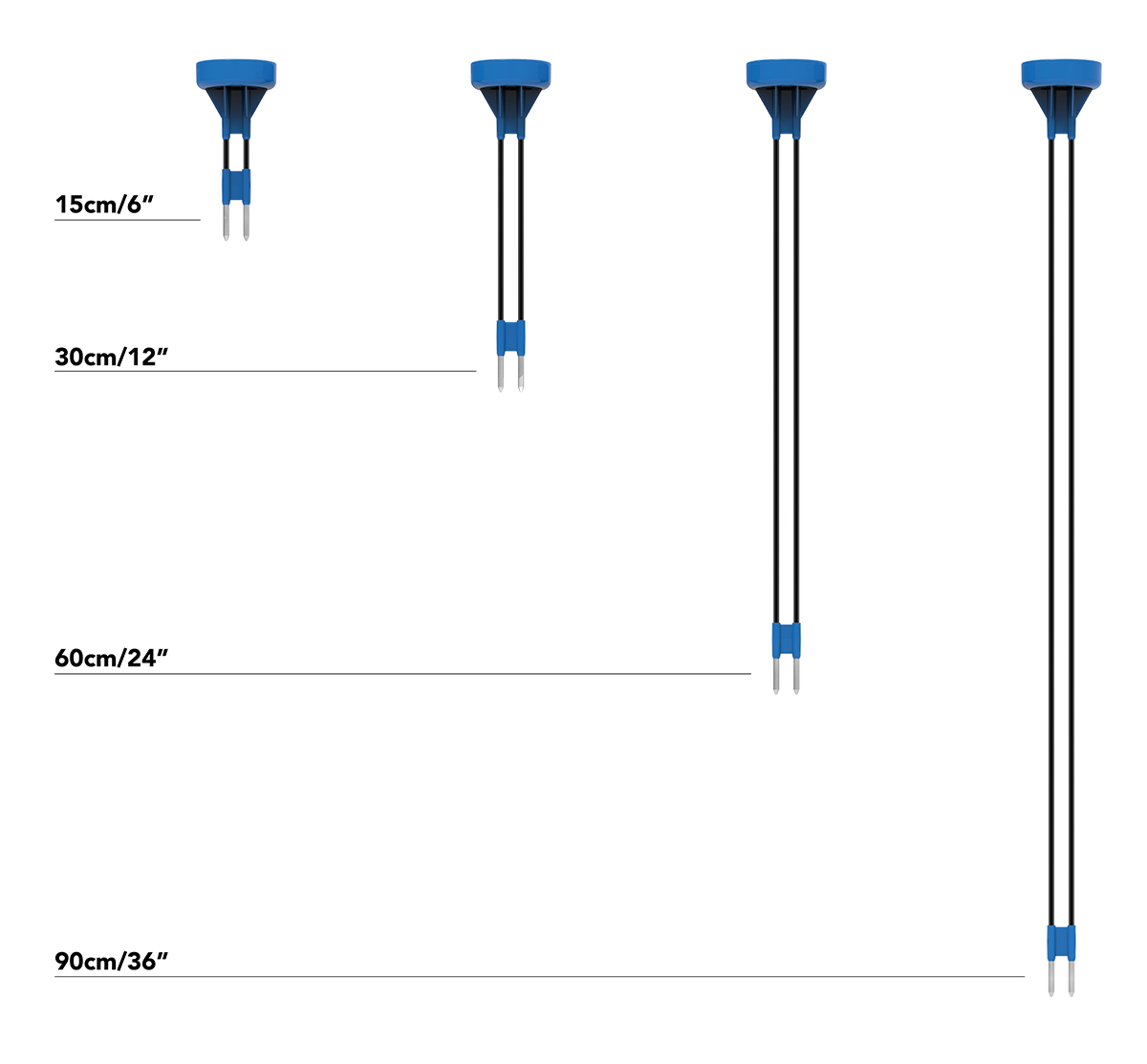
8. How do I know which sensor depth is right for my crop?
-
15 cm (6″): Ideal for shallow-rooted “Winter Salad Bowl” vegetables (Lettuce, Spinach) in the Salinas Valley.
-
30–60 cm (12–24″): Best for row crops and young vineyards.
-
90 cm (35″): Critical for established almond, walnut, and pistachio orchards to ensure deep-soak irrigation is reaching the full root profile.
9. What if I don’t have a reliable cellular signal in my remote blocks? The sensors use LoRaWAN (Long Range Wide Area Network). You only need one “Gateway” with a signal to cover a radius of up to 3 miles. The sensors talk to the gateway, and the gateway sends the data to the cloud, making it perfect for the vast, often disconnected acreages of the Central Valley.
10. Do I need a technician to install or calibrate these? No. We know labor is tight. These are hammerable probes—a ranch hand can install one in under 60 seconds using a simple dead-blow hammer. There is no wiring, no solar panel to aim, and the app uses a simple “Traffic Light” (Blue/Green/Red) system so anyone on your team can make an instant irrigation decision.