Sensoterra Agro · Vineyards
Soil moisture sensors for vineyards, block by block
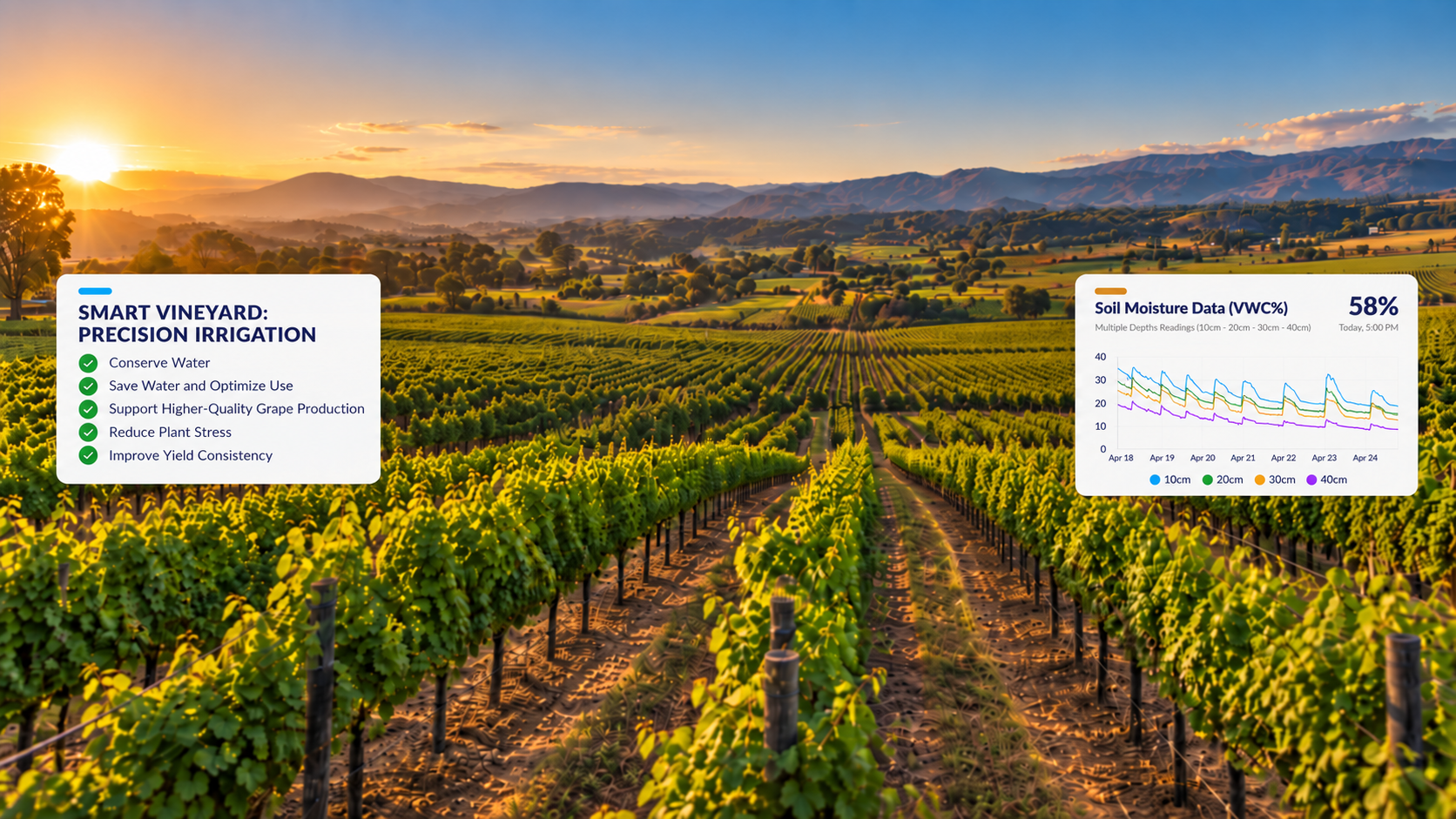
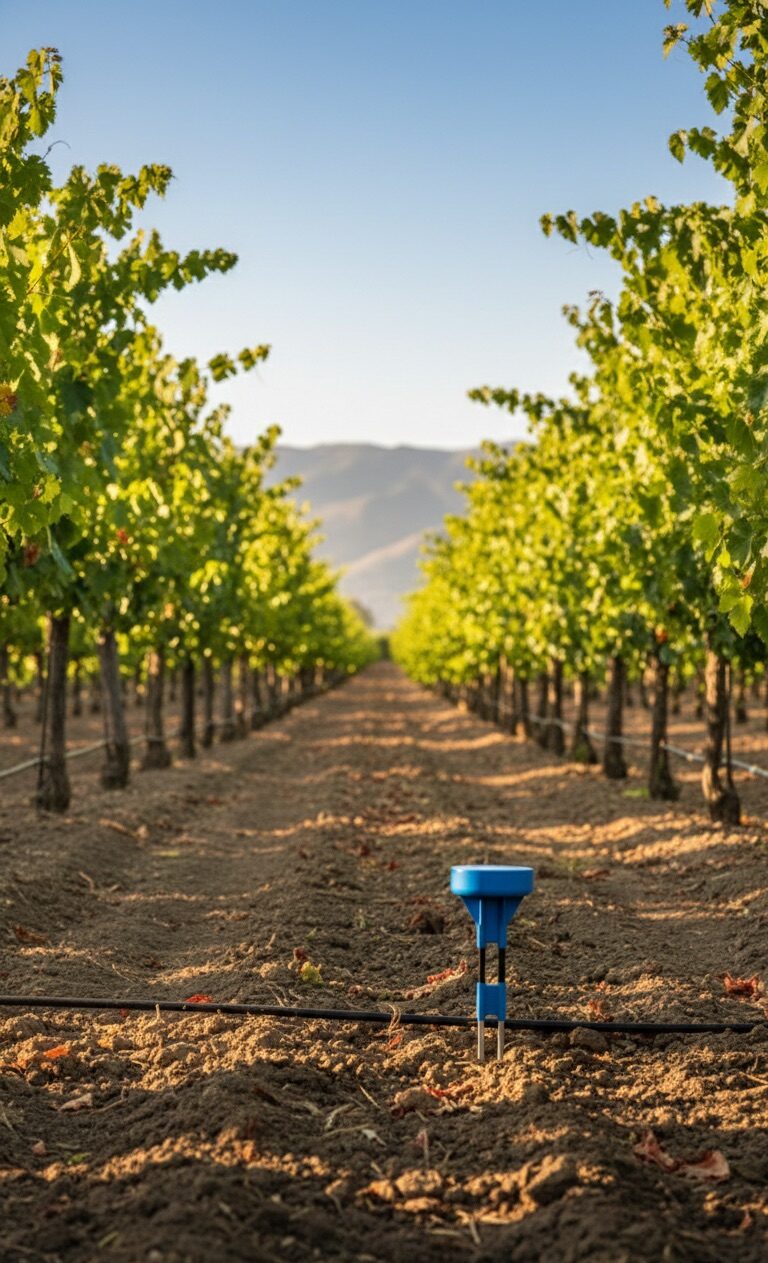
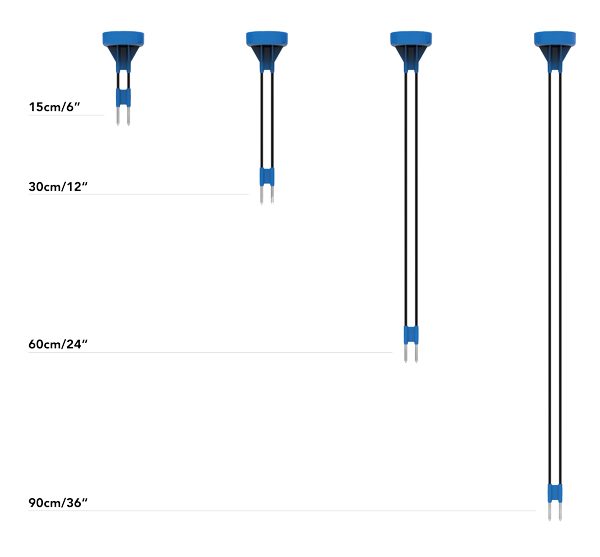
Slope, aspect and soil type can split one vineyard into several water regimes. Sensoterra's wireless soil moisture sensors measure volumetric water content at 15, 30, 60 or 90 cm, calibrated to your soil, and send a reading every hour. Put a sensor in each zone and you can irrigate every block to its own threshold instead of one schedule for the whole vineyard.
Hammer-in install · IP67+ · 5–8 years of battery life (SD Gen 2.5 tech sheet)
Calibrated VWC
Each reading is calibrated to your soil type, so the number fits the soil it came from.
5–8 years of battery life
Install once and get hourly readings for several growing seasons.
Wireless, hammer-in install
No cables between the rows. Moving a sensor to another block takes minutes.
Terrain variability
Why does one vineyard block need different amounts of water?
Because slope and aspect move water and heat around, even before soil type comes into it. The bottom of a slope stays wet longest, the top dries first. If you measure each zone separately, you can give each one the water its vines actually use.
Lower slope
Water collects here and the water table sits higher. The usual risk is overwatering, and fruit from the lower slope often tastes noticeably different.
Mid slope
Drainage and retention roughly balance out, so these vines usually need the least adjustment of the three.
Upper slope
Dries out first and gets the most heat. It usually needs longer or more frequent irrigation sets.
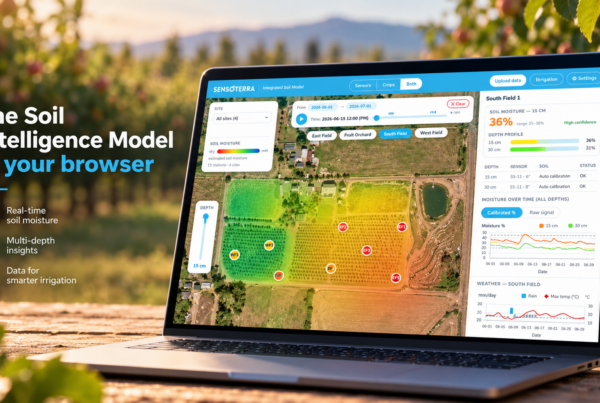
A sensor in each zone tells you what happens at that spot. The Sensoterra Soil Intelligence Model fills in the rest: it interpolates between your lower-, mid- and upper-slope sensors, weighted by soil type and elevation, and maps the moisture gradient across the whole block. That includes the transition areas a single sensor can't see, and the map shows how reliable the estimate is in each part of the block.

Calibrated VWC
How does soil calibration make vineyard readings accurate?
Sensoterra sensors measure volumetric water content (VWC) and convert it with a calibration curve for your soil type. With a suitable calibration the SD Gen 2.5 tech sheet gives an accuracy of ±1.5 volume percent at pF 2 and drier. That matters in vineyards, where small moisture differences can change berry composition.
The curve comes from AI Calibration, which selects the matching profile from the soil library built in our own lab. You don't have to set anything up. For blocks that don't fit a standard profile, AI Calibration can build a custom curve for that location.
With that data, growers can optimize:
- Timing of irrigation sets, per zone rather than the whole block
- Water application depth, matched to what the soil can actually hold
- Block-specific irrigation strategies, instead of one schedule for the vineyard
- Fruit quality, by avoiding both over- and under-watering per zone
- Water use in peak season
The model in context
Measure, explain, decide: three layers, one irrigation call
Your setup works in three layers. The sensor measures: hammered in once, maintenance-free, one spot measured precisely and calibrated to the soil it sits in. The Soil Intelligence Model explains: it fills in the space between and around your sensors, so a handful of points becomes a picture of the whole block. Sensoterra Assist decides: it turns that picture into an action which block, when and how much.
Every estimate is a weighted blend of your own sensors, nearby sensors, other depths, soil survey data, weather and evaporation, your irrigation records and your own field feedback, always judged against the soil at that spot. So dry on a gravelly upper slope means something different from dry in clay loam at the foot of the slope.
A point → an area → a decision
Irrigation control
Can the data steer my irrigation system?
Yes, through the controller or platform you already use. The Soil Intelligence Model does the slope-specific analysis. You can act on it yourself in the Sensoterra Monitor app, with thresholds and alerts per zone, or send the data to your irrigation controller through the Soil Intelligence API or one of our irrigation integrations. Your controller can then handle:
- Slope-specific irrigation steering
- Starting and stopping irrigation on moisture thresholds
- Watering intervals based on soil moisture instead of a fixed clock
- Better control over pre-harvest water management
That way irrigation follows what the vines use, which helps both wine quality and water use. For an example of Sensoterra data inside a vineyard platform, read how Fallon Place Wine uses it in eVineyard.
See the technology
Connectivity
Do vineyard sensors work in remote or hilly terrain?
Yes. The sensors send their data over LoRaWAN, a long-range radio network. Where a public LoRaWAN network covers your blocks, through Sensoterra's network partnerships, a sensor connects as soon as it's in the ground and you don't need a gateway of your own.
Where there is no coverage, we supply a managed LoRaWAN gateway with an Ethernet or 4G connection.
- Public LoRaWAN coverage through our network partners
- A managed gateway (Ethernet or 4G) where there's no coverage
- Hourly readings sent to the cloud
Common questions
What vineyard managers ask before they order.
How are vineyard blocks divided into management zones?
Zoning typically combines three criteria: soil type and depth, topography (slope and aspect), and vigour mapping (usually derived from aerial imagery like NDVI). The Sensoterra Soil Intelligence Model starts from similar inputs: it combines soil type, topography and your sensor placement into one picture of the block. For larger or more varied vineyards, an area analysis and measurement plan shows where sensors should go.
What role does controlled water stress play around véraison?
Controlled stress limits berry size while concentrating existing compounds. This stress triggers a defense mechanism in the vine, increasing anthocyanins (color) and tannins (structure) in the grape skins. Both matter for high-quality red wines. Hitting a precise deficit-irrigation target relies on knowing actual VWC, not an estimate, and per-zone readings let you apply that stress deliberately without tipping into vine damage.
What's the dual role of cover crops in a vineyard row?
Cover crops compete with the vines for water, which helps control vigor and induce stress, while also improving soil structure and preventing erosion. With cover crops in the row, irrigation needs closer monitoring so the vines get enough water too, especially in peak season.
Why is drip irrigation preferred over sprinklers for wine grapes?
Drip delivers water directly to the root zone, maximizing efficiency and minimizing evaporation. Just as importantly, it keeps the canopy and fruit dry, which lowers the risk of fungal diseases like downy and powdery mildew.
How does a vineyard's yield goal shape its irrigation philosophy?
High-volume vineyards irrigate to maintain higher VWC, maximizing berry size and weight. Premium low-volume vineyards induce chronic, mild water stress to limit berry size, concentrate flavor, and improve the skin-to-juice ratio. They apply much less water per ton of fruit.
Why does rootstock choice matter for an irrigation strategy?
Rootstocks vary in their tolerance to drought, salinity, and wet feet. A drought-tolerant rootstock can handle longer periods between irrigation sets than a non-tolerant one. In effect, the rootstock sets the vine's stress threshold.
Does monitoring change during critical growth stages?
Flowering and fruit set are usually the most sensitive: a severe deficit here can cause poor fruit set (coulure or shatter) and drastically cut the season's yield. Bud break and véraison are worth watching closely too. Per-zone data lets you tighten thresholds only where a stage makes a block sensitive, rather than across the whole vineyard.
How does canopy density relate to a vine's water need?
Leaf Area Index (LAI), or simply canopy width and height, is the usual indirect indicator. A dense, oversized canopy often points to high vigor from too much water or nutrients, and to a higher water demand. A smaller, balanced canopy suggests the vine's water supply is already under control.
How does rocky or gravelly soil affect VWC readings compared to loam?
Rocky soils hold much less water than loam, so the same volume of water applied results in a lower VWC reading, and that reading drops faster. Rocky blocks need shorter, more frequent irrigation sets to avoid sudden stress, and that is where soil calibration per field pays off.
What about irrigation after harvest?
Post-harvest watering supports vine recovery and next season's bud development, and gives the vine enough moisture while it builds up carbohydrate reserves, the energy it draws on for winter survival and next season's bud break. Monitoring after harvest helps you keep watering reduced rather than stopping, without guessing the amount.
How does soil calibration work?
You pick your soil type in the Sensoterra Monitor app, or AI Calibration selects the matching curve from our soil library. Where no standard curve fits, a custom curve can be made for that location.
Which sensor depth should I use in a vineyard?
The Single Depth sensor comes in 15, 30, 60 and 90 cm. The Multi Depth sensor measures at six depths, from 10 to 90 cm, in one device, so you can see whether water reaches the deeper roots or stays near the surface.
How long does the battery last?
5 to 8 years, according to the SD Gen 2.5 tech sheet, with a reading every hour. You can leave the sensor in the ground between seasons.
Can I combine vineyard sensors with a broader field view?
Yes. Pair your sensors with field-level soil moisture mapping to see the picture between the probes, across every slope zone.
About Sensoterra
Established in 2015 and headquartered in Enschede, the Netherlands, Sensoterra develops wireless soil moisture sensors and the Soil Intelligence Model, a predictive field-level soil model. Sensoterra Agro serves growers and researchers in orchards, vineyards, berries and trial fields worldwide. The sensors and the model are API-first: you can use the data in our own tools or feed it into the platform you already work with.
Get a quote
A quote built around your blocks, your slopes, your soil.
Tell us about your vineyard and we'll put together a quote for your setup, including what the model shows once your lower-, mid- and upper-slope zones are connected.
Already using Sensoterra sensors?
We'll layer the model on top of the sensors already in your blocks.
New to Sensoterra?
We'll walk through your slopes and soil types first. No commitment needed to see it.