Reduce tree mortality in California orchards with real-time soil moisture data. Monitor multiple depths, understand terrain-driven water movement, and optimize irrigation for almonds, walnuts, cherries, and apples.
Reduce tree mortality from terrain and gravitational pull
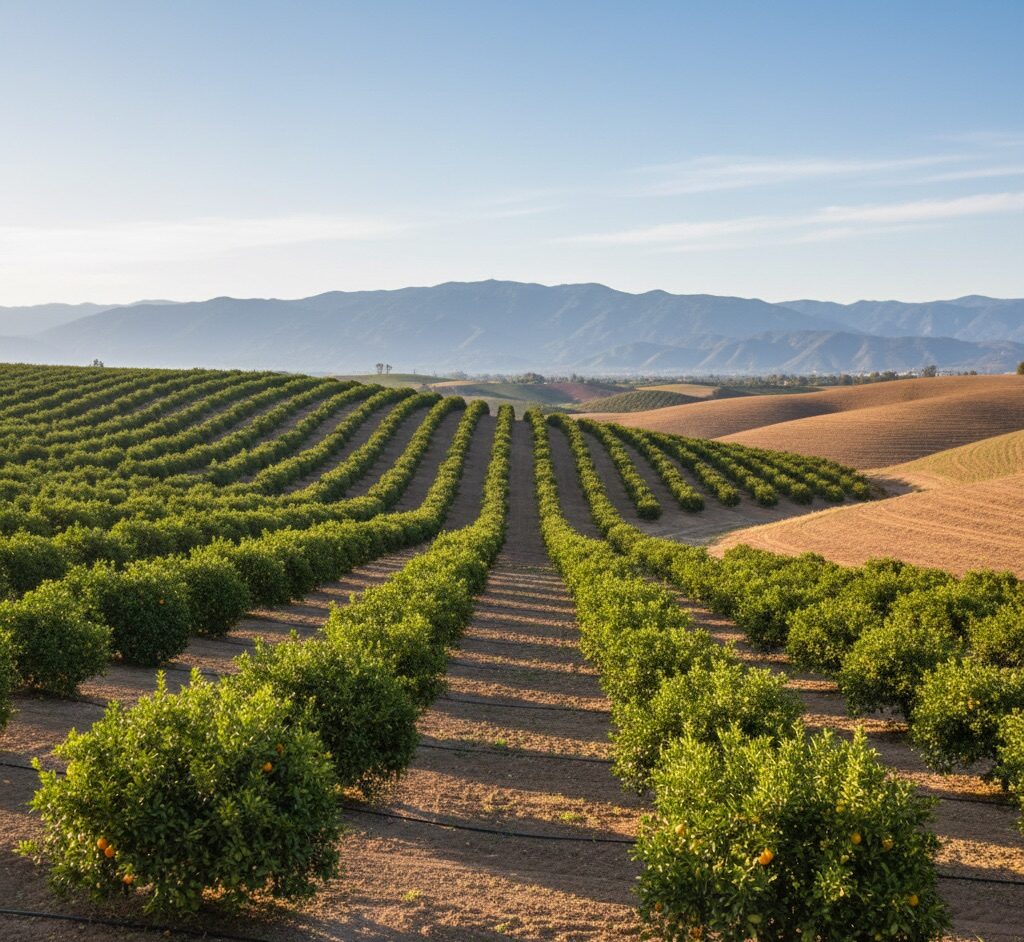
California is known for it’s vast orchards, feeding the world, but facing unique irrigation challenges tied to terrain. Even small topographical shifts can drastically affect water distribution, leading to stressed trees at the top of slopes and waterlogged trees at the bottom. This variability is one of the most common, and most costly causes of orchard yield loss and tree mortality.
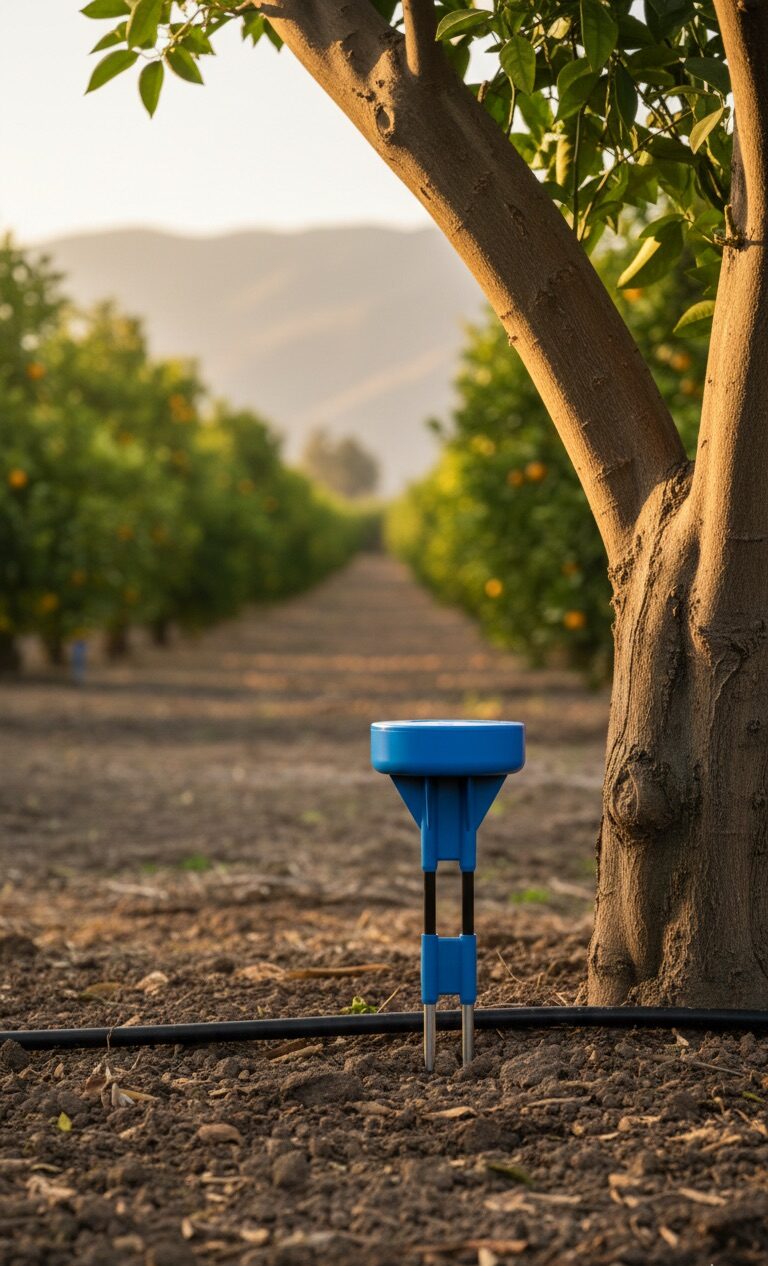
Soil moisture monitoring at multiple depths helps growers understand these hidden patterns, protect trees, and adjust irrigation more strategically. Sensoterra offers a simple, scalable solution with multi-depth VWC insights and connectivity that works out of the box.
How terrain and gravitational pull affect orchard moisture
In sloped orchards, gravitational pull causes water to migrate downslope and settle deeper in the soil profile. Lower-elevation trees often sit above slightly elevated groundwater or shallow saturated layers, especially after heavy irrigation or spring rainfall.
This leads to:
- Root oxygen stress
- Delayed nutrient uptake
- Disease (Phytophthora) vulnerability
- Tree decline or collapse
At the top of the slope, trees experience the opposite problem:
- Faster drying
- Chronic mild stress
- Lower productivity
Without real-time soil moisture data, many orchard managers irrigate uniformly across entire blocks, unintentionally overwatering some trees and underwatering others.
Soil moisture sensors help growers divide irrigation zones based on slope instead of treating entire fields as uniform. With real-time VWC data, it’s easy to see when lower slopes are still above target moisture while upper slopes are already falling below.
Multi-depth data reveals what’s really happening
With Sensoterra, growers and irrigation managers can quickly see moisture levels at multiple depths. This helps answer critical orchard questions:
- Is the lower root zone staying saturated too long?
- Are upper-slope trees drying faster between cycles?
- Are mid-slope trees benefiting from water movement?
- Is water infiltrating deep enough after each irrigation?
- Are we applying more than the soil can absorb?
This depth-based visibility makes irrigation steering more precise and directly reduces tree mortality.
Automation across varied terrain
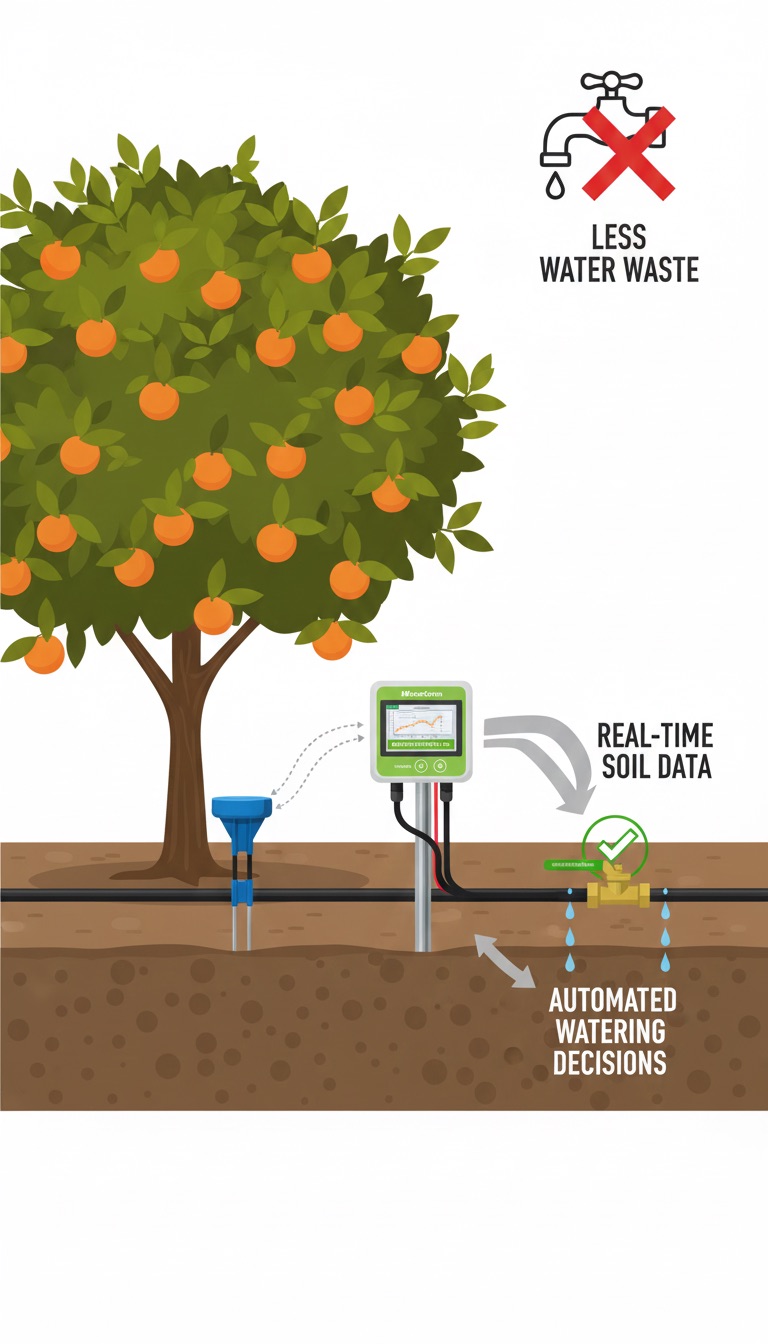
Sensoterra grows with your needs. Start monitoring soil moisture with Sensoterra, managing soil moisture levels and irrigation schedule adjustment. The Sensoterra data can be integrated into your existing irrigation platform, without having to change sensor hardware, so you can have all data in one place for irrigation management, and even automation. This enables slope-specific irrigation strategies such as:
- Shorter, more frequent cycles in low-lying areas
- Longer pulses for upper-slope trees
- Block division guided by real sensor data
- Automatic on/off steering based on moisture thresholds
Connectivity that removes complexity
Orchards often span large acreage far from infrastructure. Sensoterra sensors connect automatically through strategic LoRaWAN partnerships — eliminating the need for private gateways or costly communications infrastructure.
Because a sensor is only useful if the data reliably leaves the field, our built-in connectivity gives orchard managers confidence that every reading shows up on time.

EQIP reimbursement
Many orchard growers in California have successfully secured EQIP funding for Sensoterra sensors. If you’re exploring grant reimbursement, we’re ready to support the process and provide documentation on our hardware to make sure you get the data you need to be successful.
Frequently asked questions (FAQ): Orchard & tree health management
1. What is the common tree disease Phytophthora, and how is overwatering a direct cause of its spread?
Phytophthora (often called ‘water mold’) is an oomycete that causes various forms of root and crown rot in orchard trees (citrus, avocado, etc.). Overwatering provides the saturated, low-oxygen soil environment necessary for the pathogen’s mobile spores (zoospores) to swim and infect the roots, leading to tree decline or collapse.
2. How does the ‘chronic mild stress’ on upper-slope trees impact fruit quality and yield in the long term?
Chronic mild water stress prevents trees from reaching optimal physiological function. This typically results in smaller fruit size, reduced overall yield, and can negatively affect sugar accumulation (Brix) and firmness, impacting market value.
3. How does Sensoterra address the challenge of placing a sensor in the most representative location in a mature orchard block?
Due to the large root spread of mature trees, sensors are typically installed beneath the drip line in the area where the roots are most active. To monitor slope variation accurately, sensors must be strategically placed in both the highest (drier) and lowest (wetter) sections of the irrigation block.
4. What is ‘root oxygen stress,’ and why does it occur in lower-elevation trees?
Root oxygen stress (or anoxia) occurs when soil pores are completely filled with water, displacing the air (oxygen) needed for root respiration. This occurs in lower-elevation trees because gravitational pull causes water to “pool” or “settle,” leading to prolonged saturation and oxygen deprivation, which is toxic to the roots.
5. If a block has both a severe slope and two different soil types, how should Sensoterra sensors be deployed?
The orchard manager should establish at least four distinct monitoring zones: two representing the different soil types on the upper slope and two representing the same soil types on the lower slope. This ensures both soil texture and slope are measured independently.
6. What is the significance of the LoRaWAN connectivity mentioned for large California orchards?
LoRaWAN is a long-range, low-power protocol vital for large orchards spanning hundreds of acres. It transmits data miles from the sensor to the internet, eliminating the need for growers to purchase and maintain expensive cell modems or complex private network infrastructure.
7. How does Multi-depth data specifically help manage young trees in an orchard setting?
Young trees have shallow root systems and are highly vulnerable to overwatering. Multi-depth sensors ensure irrigation is confined to the shallow, active root zone (e.g., the 10cm sensor). Monitoring the deeper sensor (e.g., 30cm) detects if water is being applied deeper than the roots can access, indicating waste and potential leaching.
8. How does ‘Delayed nutrient uptake’ occur in water-saturated lower slopes?
Nutrient uptake requires energy produced by aerobic respiration (using oxygen). When soil is saturated (anoxia), oxygen is depleted, causing the roots to shut down. This prevents the tree from actively absorbing essential nutrients like Nitrogen (N) and Phosphorus (P), even if they are present in the soil solution.
9. How often should the VWC data be reviewed by the orchard manager during the critical growing season?
The data should be reviewed at least once daily during the peak growing season, especially before starting an irrigation cycle. This allows the manager to track the previous day’s water use and confirm the VWC is approaching the lower irrigation threshold in a timely manner.
10. What documentation support can Sensoterra provide to a grower applying for EQIP funding?
Sensoterra would typically provide detailed documentation including a full technical specification of the hardware, a cost breakdown, and documentation explaining how the technology meets the specific resource conservation criteria (like water savings and irrigation efficiency improvement) required by the EQIP program.
About Sensoterra
Sensoterra takes the lead in wireless soil moisture sensor technology, offering cutting-edge IoT solutions for smart agriculture. Our state-of-the-art moisture sensors are pioneers in the field of soil moisture monitoring. We are committed to revolutionizing precision agriculture, helping farmers optimize their irrigation systems and promote sustainable farming. With Sensoterra, you gain real-time access to critical soil moisture data, empowering you to manage water resources with precision. Established in 2015 and headquartered in Houten, The Netherlands, Sensoterra develops innovative water management solutions for agriculture, horticulture, smart city management, and water governance. Our global network boasts over 12,000 moisture probes in the ground, generating an abundance of data points daily. Jessica Nuboer Marketing & Communications Sensoterra Email: [email protected]