Improve berry irrigation with real-time soil moisture data, slope-based scheduling, automated irrigation, and reliable connectivity. Sensoterra offers calibrated VWC data for more consistent berry production.
Smart irrigation for California berry production
California’s berry industry depends on precision. Strawberries, blueberries, and blackberries are highly sensitive to water availability, and even small variations can influence fruit size, flavor, uniformity, and disease pressure. With short irrigation windows, unpredictable weather patterns, and increased scrutiny on water use, growers need a way to make irrigation decisions that are accurate, fast, and field-specific.
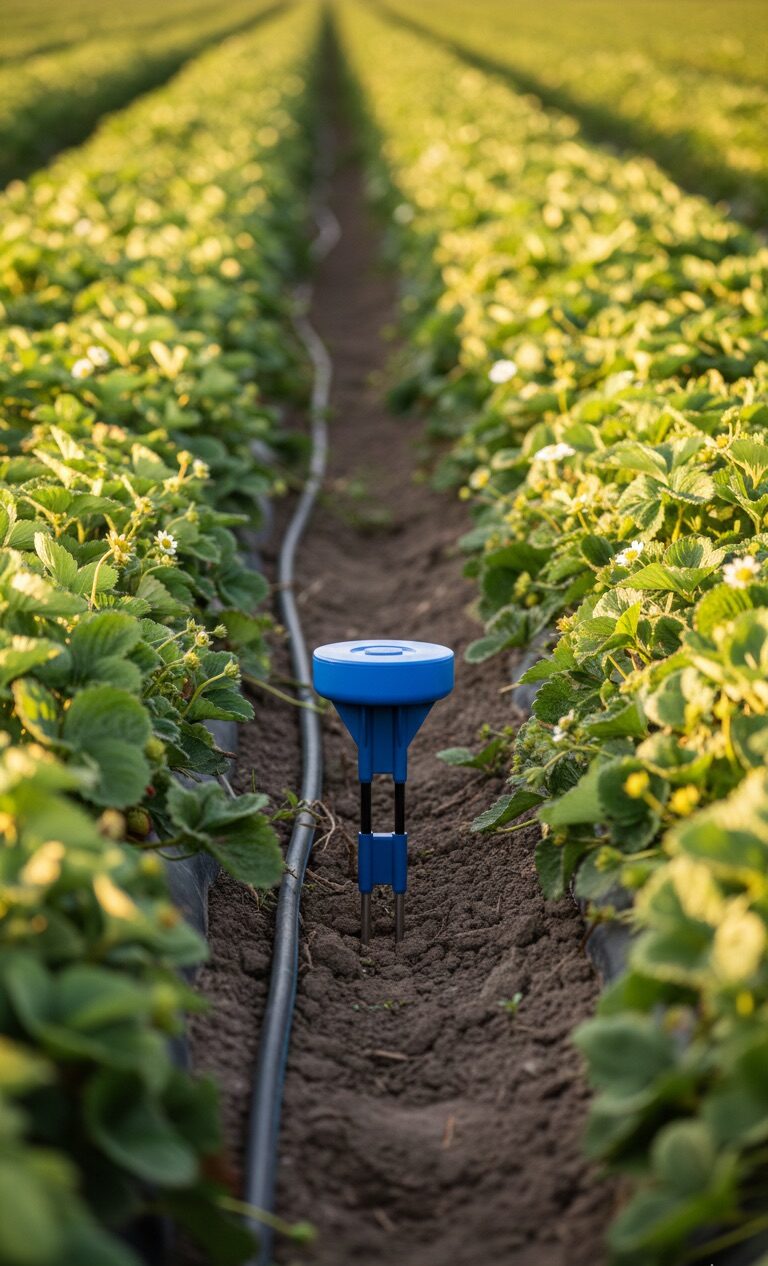
Real-time soil moisture monitoring gives berry growers a clearer, more consistent way to manage irrigation, without relying on guesswork, outdated scheduling, or expensive infrastructure. Sensoterra stands out by delivering calibrated volumetric water content (VWC) data, plant available water thresholds (PAW), long-lifetime wireless hardware, and connectivity that works out-of-the-box across California.
Slope-based zone division for better berry irrigation
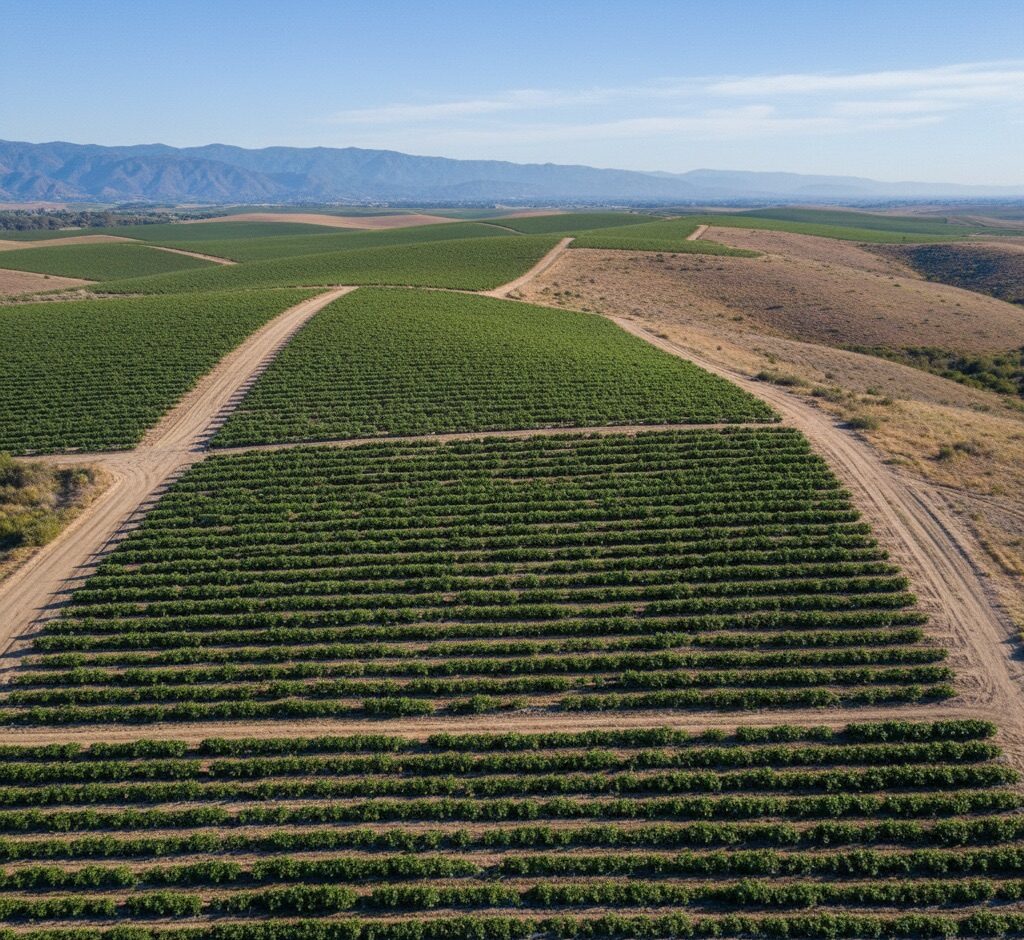
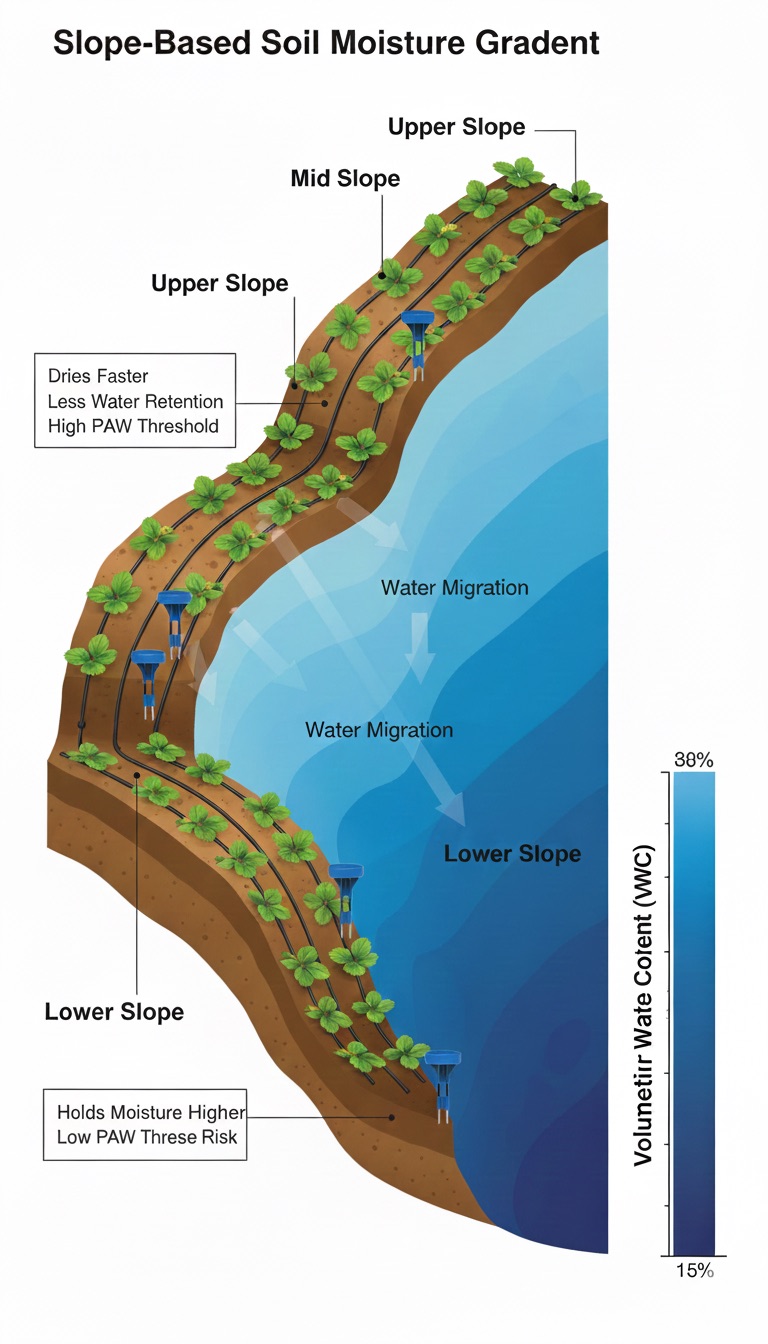
While berry farms may not experience extreme terrain undulation, sloping is common, and even a slight gradient affects water distribution. Drip lines on raised beds naturally allow water to migrate downslope, creating moisture imbalance across the field.
Lower beds often:
- Hold moisture longer
- Show delayed drying after irrigation
- Increase disease risks
- Produce inconsistent fruit sizing
Higher beds often:
- Dry faster
- Require more frequent cycles
- Are prone to uneven fertigation uptake
Soil moisture sensors help growers divide irrigation zones based on slope instead of treating entire fields as uniform. With real-time VWC data, it’s easy to see when lower slopes are still above target moisture while upper slopes are already falling below.
Connectivity that works without extra effort
Many soil sensors fail not because of poor hardware, but because their connectivity is unreliable. Sensoterra eliminates this risk by working with strategic LoRaWAN partners across California, ensuring that your sensors connect right out of the box, without complicated or pricy installation fees.
If you want real-time irrigation decisions, your data must reach you every day, and Sensoterra ensures it does.
Automation With Your Existing Irrigation System
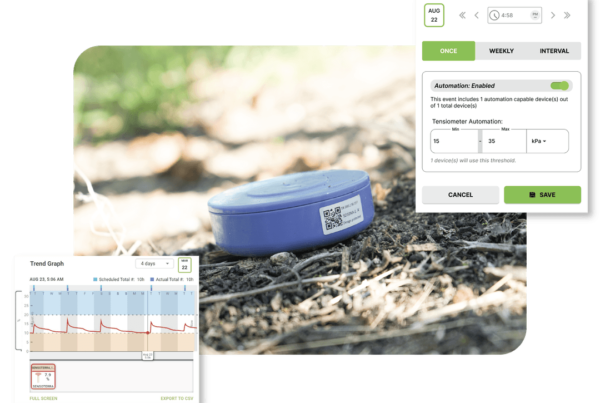
If you’re planning to transition toward automated irrigation steering, Sensoterra integrates easily with ANY irrigation hardware supplier, like:
- WiseConn
- Netafim
- Jain
- Rainbird
- Hunter
- And more
You choose the platform. Sensoterra sends the real-time moisture data that informs smarter, fully automated irrigation decisions.
Why Berry growers choose Sensoterra
- 99.5% accurate soil-type calibration for plant available water
- 100% Wireless, maintenance-free sensors
- Easy installation in under a minute
- Hourly data, over a long lifetime (5–8 years)
- Dutch-designed, made in Europe
- Trusted globally with 20,000+ installations
Get ready for the upcomming season
Now is the ideal time to prepare your berry irrigation strategy. Sensoterra offers scalable sensor packages for every operation:
- 50-acre starter package
- 100-acre package
- 200-acre package
- Custom deployments for 2,000+ acres
Whether you manage a single berry ranch or multiple fields, Sensoterra gives you the real-time soil moisture data needed for smarter irrigation decisions.
Request a Quote today, or reach out directly to call or email your inquiry. We’ll help you get set up quickly so you start collecting high-quality data from day one.
Frequently asked questions (FAQ): Smart irrigation for berries
1. What is the typical percentage of water savings a California berry grower can expect when switching to VWC-based smart irrigation?
Growers often achieve water savings ranging from 15% to 30%. This efficiency gain comes from eliminating unnecessary irrigation cycles and precisely applying water only when soil moisture drops below the Plant Available Water (PAW) threshold.
2. How do California state water restrictions and programs like the Sustainable Groundwater Management Act (SGMA) influence the decision to adopt smart irrigation technology?
SGMA mandates groundwater sustainability, requiring growers to document and prove efficient water use. Smart irrigation tools aid compliance with regulations and help protect water rights during periods of scarcity.
3. What is the generally recommended optimum VWC (Volumetric Water Content) range for high-yield strawberry production in typical sandy-loam soils?
The common target range for peak productivity in sandy-loam fields is typically between 18% and 25% VWC. Irrigating within this “sweet spot” ensures high yields and optimal fruit quality, preventing stress (< 15%) or saturation (> 30%).
4. What common fungal disease in California berry production is exacerbated by the over-watering conditions identified in lower-slope irrigation zones?
The major concern is Phytophthora root rot. This water mold thrives in the saturated, low-oxygen conditions that occur when lower beds hold moisture longer, directly correlating with increased disease risk.
5. What is the primary alternative soil moisture sensing technology to VWC sensors, and what are its main drawbacks?
The main alternative is the Tensiometer, which measures soil water tension (pressure). Its primary drawbacks include the need for frequent maintenance (refilling with water) and its inability to provide a direct volumetric percentage for easy automation.
6. How is the crop-specific Plant Available Water (PAW) threshold determined using the two main soil moisture metrics?
PAW is the amount of water available between two critical metrics: Field Capacity (FC) (the upper limit of water held after drainage) and the Permanent Wilting Point (PWP) (the lower limit where the plant irreversibly wilts). PAW = FC – PWP.
7. What is the general estimated initial investment cost per acre for a full sensor-based smart irrigation system?
The estimated initial setup cost, including hardware and gateways for moderate density, often ranges between $150 to $300 per acre. This is typically followed by an annual data subscription fee of $20 to $50 per sensor/year.
8. What is the main limitation or challenge of using LoRaWAN connectivity in a large, undulating berry field with dense foliage?
LoRaWAN is highly sensitive to line-of-sight obstruction. Dense foliage and rolling terrain can attenuate or block the signal, requiring strategic placement of the LoRaWAN gateway (antenna) to ensure reliable data transmission.
9. How does precise soil moisture monitoring directly improve Fertigation (fertilizer application efficiency) in berries?
By stopping irrigation before the water exceeds Field Capacity, the system minimizes nutrient leaching below the shallow root zone. This boosts the efficiency of costly, soluble fertilizers and reduces runoff.
10. Why is measuring soil moisture at multiple depths (e.g., 6 inches and 18 inches) crucial for optimal berry irrigation compared to a single-depth sensor?
Multi-depth sensing provides insight into water movement: the shallow depth (6 inches) monitors the **active root zone** (when to irrigate), while the deeper depth (18 inches) monitors leaching (was too much water applied?). This allows for fine-tuning of irrigation cycles.
About Sensoterra
Sensoterra takes the lead in wireless soil moisture sensor technology, offering cutting-edge IoT solutions for smart agriculture. Our state-of-the-art moisture sensors are pioneers in the field of soil moisture monitoring. We are committed to revolutionizing precision agriculture, helping farmers optimize their irrigation systems and promote sustainable farming. With Sensoterra, you gain real-time access to critical soil moisture data, empowering you to manage water resources with precision. Established in 2015 and headquartered in Houten, The Netherlands, Sensoterra develops innovative water management solutions for agriculture, horticulture, smart city management, and water governance. Our global network boasts over 12,000 moisture probes in the ground, generating an abundance of data points daily. Jessica Nuboer Marketing & Communications Sensoterra Email: [email protected]