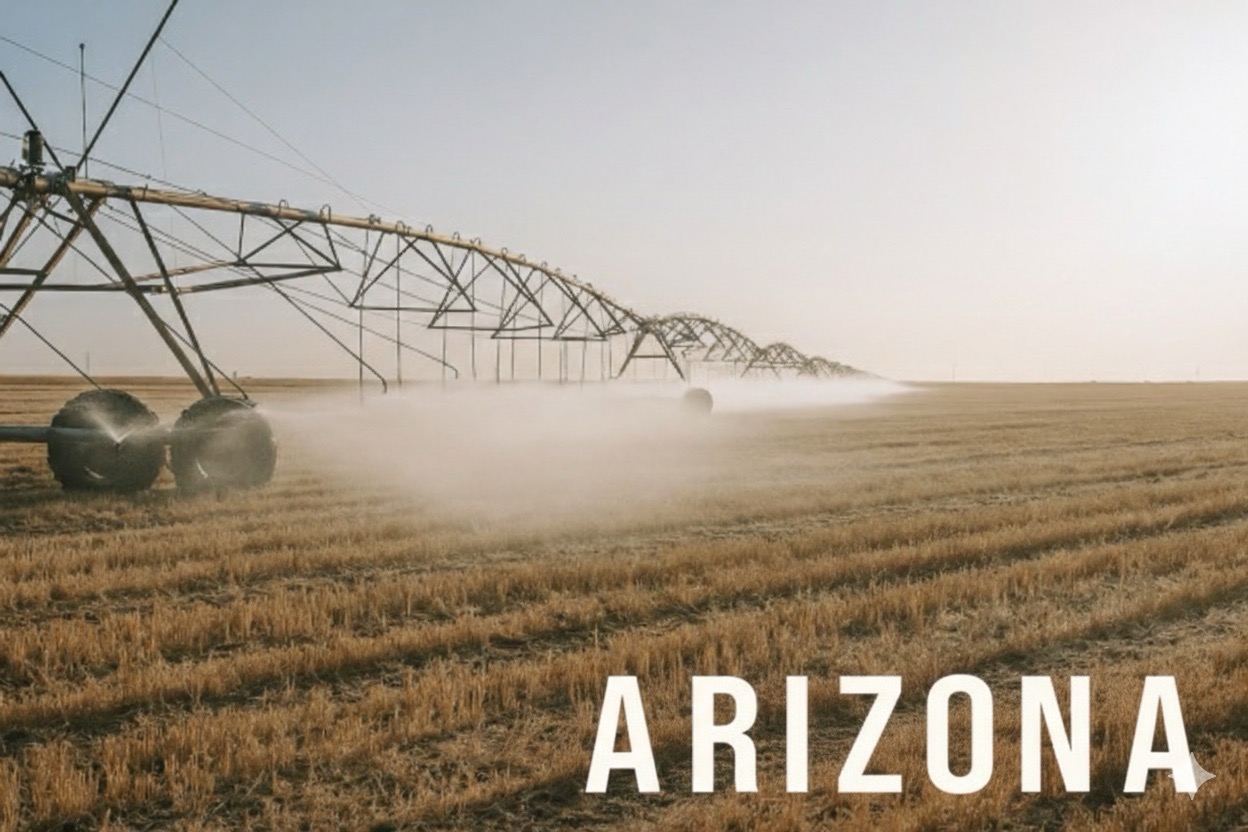
Precision irrigation for the toughest dirt on Earth.

And that toughest dirt, needs the toughest soil moisture sensor in-market. Stop guessing and start growing, put the sensor in the ground and leave it there for 8+ years. Protect your crop quality, cut overhead miles and water waste, beat the heat.

Rising Pumping Costs: As the Colorado River levels drop, groundwater pumping is getting deeper and more expensive.

Stiff Regulations: Stay ahead of ADWR (Arizona Department of Water Resources) conservation requirements without the paperwork headache.

Extreme Heat Stress: When it’s 115°F, “guessing” if your crop has enough water leads to bolting, tip-burn, and lost yield.
Used in 3,000+ fields across the U.S.

Single depth sensor all lengths

100% maintenance free

No wires, no fuss

Highly secure data connection

Suitable for all soil types

Engineered for arizona’s toughest terrain

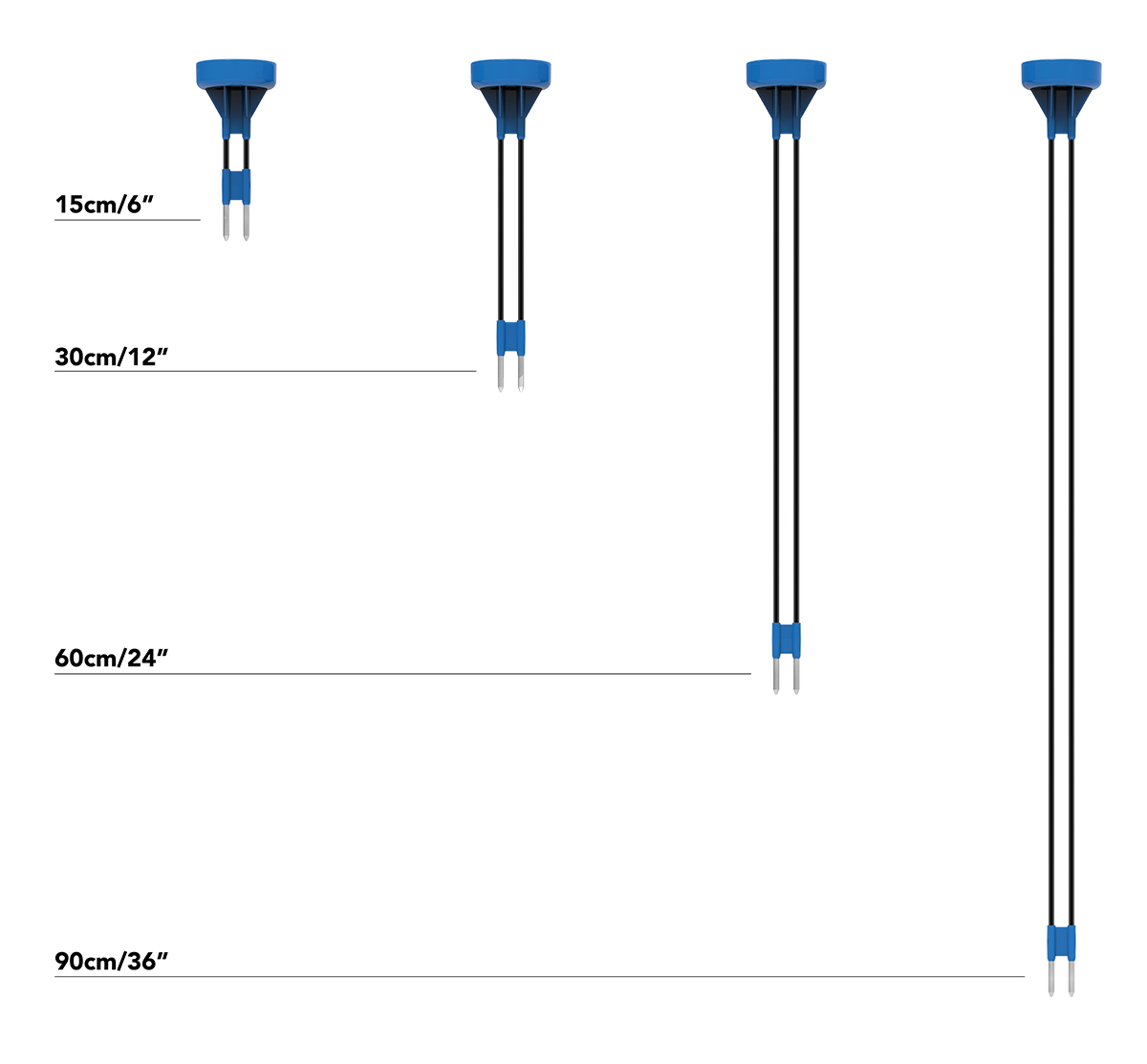
Designed for the diverse landscapes of Arizona, our hammerable probes utilize Sensoterra’s patented moisture measurement technology to provide hourly, precise data even in the state’s toughest conditions. Built to withstand installation in dense soils without extra tools, these rugged sensors offer real-time root zone visibility across a variety of fixed depths ranging from 15 cm (6″) for shallow-rooted crops like Yuma Romaine to 90 cm (35″) for deep-rooted Willcox Pecans. With built-in LoRaWAN connectivity and a 6–10 year battery life, you can monitor moisture trends and irrigation thresholds directly from your phone through our best-in-class API and mobile app.

With automatic calibration for desert-specific soil types, you get high-precision data across every acre. whether you are managing delicate spinach crops or established date palms, our sensors provide the insights you need to thrive.

  • Hourly measurements, 6-8 years battery life
  • Completely wireless (including datalogger)
  • Robust and easy to install without additional tools (hammerable)
  • Minimal soil disturbance
  • 100% maintenance free
  • Easy access to data – API-first
  • Compatible with all soil types (>45 standard calibrations)
  • High security data connections and database

Subsurface drip: Date palms

Precision irrigation for date palms in Arizona and the Middle East
Scalable data & real-time insights with fully integrated smart IoT systems

Date palms

Trusted by Arizona/California Growers

“It took me ages to find a durable and accurate moisture sensor. The sensor is feeding data into the eVineyard platform and it lets me create a model of soil moisture across the different root Zone depths and monitor it to make sure it stays in the proper zone. The vines look a lot healthier this year utilizing the tool with the adjusted soil profile” – Cory Michal, Fallon place wines

Available directly from us or through our local partner Verdi AG

Maximize every acre: Real-Time insights for Arizona’s high-stakes crops

In the Arizona desert, the margin for error is razor-thin. Whether you are managing the high-value leafy greens of the Yuma “winter salad bowl” or the massive water demands of alfalfa and forage, precision is the only protection against rising costs and shrinking water allocations. These sensors provide the granular, real-time data needed to maintain the delicate balance of the root zone: Preventing “bolting” in lettuce during sudden heat spikes and ensuring deep-rooted pecans and citrus receive the strategic deep-soaks necessary for effective salt leaching. For legacy crops like cotton, multi-depth monitoring allows you to track water penetration through dense caliche layers, ensuring that every drop reaches the plant rather than evaporating in the sun. By moving from a calendar-based schedule to a data-driven strategy, you are not just saving water you are protecting crop quality and securing the future of your farm.

Soil series Region / typical crops Texture / drainage Key feature for soil moisture sensing
Casa grande Pinal & Maricopa counties — cotton, alfalfa, and small grains Fine-loamy (sandy loam to clay loam subsoil) Prone to high salinity; sensors must be able to distinguish between salt-driven conductivity and actual moisture levels.
Mohave Western Arizona (Yuma area) — leafy greens, citrus, and dates Sandy loam surface with heavy clay subsoil Well-drained surface but holds water at depth; sensors help prevent “leaching” of expensive fertilizers past the root zone.
Vinton Yuma and Gila river floodplains — vegetables, lettuce, and melons Loamy fine sand / coarse-loamy Very fast drainage; real-time alerts are critical here because the soil can go from optimal to “wilting point” in hours during 100°f heat.
Pima River floodplains (Maricopa/Pinal) — pecans, cotton, and forage Fine-silty (deep, fertile silt loams) Extremely high water-holding capacity; sensors help farmers avoid over-saturation and “wet feet” which leads to fungal root rot in pecan orchards.
Anthony Alluvial fans and desert washes — orchards and grapes Sandy loam / gravelly Contains high amounts of calcium carbonate (lime); sensors must be durable enough for installation in rocky or gravelly profiles.

A Breakthrough Partnership: UC Davis

Growing crops in California means dealing with heat, drought and increasing soil salinity, making accurate irrigation decisions more critical than ever. With new UC Davis–validated calibration curves, Sensoterra soil moisture sensors now deliver even more reliable readings for California’s most common soil types.

Full article

A research collaboration with the University of California Davis

California farmers face growing challenges with salinity, drought, and changing soil conditions. In partnership with the University of California Davis, Sensoterra has validated how soil type, salinity, and temperature influence moisture readings—and developed new calibration curves for Oso Flaco sand, Columbia loam, and Yolo clay loam. This means growers across California’s diverse soils can now make more accurate irrigation decisions, reduce water waste, and protect crop yields, even in saline-prone regions. With proven performance in local soil conditions and support from one of the world’s leading soil research institutes, Sensoterra gives farmers reliable insights to manage water smarter.

Frequently asked questions (FAQ): Soil moisture probes in Arizona

1. Can these sensors survive a 40,000-lb tractor or harvester passing over them?

Yes, because the sensors are subsurface. Since there are no wires or external antennas, you can install them below the “tillage line” or simply drive directly over them. They are designed to be flush with the soil or completely buried, meaning they won’t get snagged by disc harrows or shredded by a forage harvester.

2. How do these help me with ADWR or local groundwater audits?

In Arizona, the ADWR (Arizona Department of Water Resources) often requires proof of conservation. These sensors provide an automated, digital “paper trail” of your water usage efficiency. Instead of manual logbooks, you can export hourly data to prove you are only irrigating when the root zone hits a specific threshold, simplifying your regulatory compliance.

3. Will the high salinity in my soil “trick” the sensor into thinking it’s wet?

Standard capacitance sensors often struggle with “salinity drift” where salt conducts electricity and mimics water. Sensoterra’s UC Davis-validated technology uses a high-frequency measurement that distinguishes between the dielectric constant of water and the electrical conductivity of salts, giving you a true moisture reading even in saline-heavy floodplains.

4. What happens during a 120°F Arizona “Heat Dome” event?

*The sensors are built with industrial-grade resins that resist thermal expansion. While the surface soil might bake, the sensor’s electronics are protected underground where temperatures are more stable. The data remains accurate, allowing you to monitor for Heat Stress and trigger “cooling pulses” of irrigation before the crop starts to bolt.

5. Can I see this data in my John Deere Operations Center?

Yes. Because the system is API-first, the data can be bridged into major farm management software. This allows you to overlay your soil moisture levels directly onto your yield maps or variable-rate irrigation (VRI) schedules.

6. Do I have to pull them out every winter?

No. One of the biggest time-wasters is the “annual harvest pull.” These are designed for an 8+ year lifespan. You can leave them in the ground through the winter, allowing you to monitor off-season moisture levels and salt-leaching effectiveness durin

7. Is my field data private? Who owns it?

This is a major concern for American growers. Sensoterra provides a highly secure, encrypted data connection. Unlike some “free” platforms that sell aggregate grower data to commodity traders, your granular field data is yours, intended for your operational decision-making.

8. How do I know which depth to choose: 6″, 12″, or 35″?

  • 6″ (15cm): Best for shallow-rooted “Winter Salad Bowl” crops (Lettuce, Spinach).

  • 12″–24″: Ideal for row crops like Cotton or Alfalfa.

  • 35″ (90cm): Critical for Orchards (Pecans, Citrus) to ensure water is reaching the deep taproots and moving past the caliche layer.

9. Can I install these in rocky “Anthony” series or gravelly soil?

Yes. Traditional sensors require a “slurry” and a perfectly smooth hole. These are hammerable. You can use a dead-blow hammer to drive them into dense or rocky soil profiles that would snap a standard plastic probe, ensuring the sensor has tight contact with the soil for accurate readings.

10. Do I need a technician or a “Data Scientist” to install and read these?

No. One of the biggest hidden costs in Ag-Tech is the “consultant fee” or the time spent training crews. Because these sensors are completely wireless (no external data logger or solar panel to wire up) and hammerable, a ranch hand can install a sensor in under 60 seconds with a standard dead-blow hammer. The data is pushed to a “traffic light” style mobile app: Blue (Too Wet), Green (Optimal), and Red (Irrigation Needed). You don’t need to interpret complex graphs to know it’s time to turn on the pumps; the system does the math for you based on your specific soil calibration.

How it has been applied in Precision agriculture

Smart California berry production

Improve berry irrigation with real-time soil moisture data, slope-based scheduling, automated irrigation, and reliable connectivity.

Berry production

Soil moisture meter for U.S. Farmers

Across the United States, water has become one of agriculture’s most limited resources. From the almond orchards of California to the cornfields of Nebraska, farmers face the same challenge

U.S. Smart irrigation

Lettuces & vegetables

Improve vegetable and lettuce irrigation with calibrated soil moisture data, Dynamic EC readings, and zone-based adjustments. Sensoterra supports consistent yield and healthier crops.

Lettuces & vegetables irrigation

Terrain-Based orchard irrigation

Reduce tree mortality in California orchards with real-time soil moisture data. Monitor multiple depths, understand terrain-driven water movement.

Orchard irrigation

Optimized vineyard irrigation

Optimize vineyard irrigation with real-time soil moisture data. Manage slope, aspect, block variability, and micro-terroir with Sensoterra’s calibrated VWC sensors.

Vineyard irrigation

Irrigation partners U.S.

Irrigation partners can expand services with Sensoterra’s easy, maintenance-free soil moisture sensors. Scalable real-time data, and reliable connectivity.

Irrigation partners

Get started with Sensoterra

To get started, answer a few short questions so we can send you a custom quote

request a quote